
As much as I appreciate convenience, this is a bit too much.


The Personal Side of Being an “Expat in Japan”
There are many expats in Japan, many of which are under the guise of the Japan Exchange and Teaching (JET) Programme. I happen to be one of those expats. It’s not so much the fact that I’m outside of the United States, my home country, that makes me an expat. It’s based off of a matter of choice; I wanted to get out of the United States. I felt suffocated being there. Don’t get me wrong, the United States is pretty cool. Home of the Free. The American Dream. But sometimes, there’s a deeper calling in life than the commercialization of everything that was once precious. I decided that I wanted to develop outside of American culture because there was a whole world to experience. Why not go to the country I’ve always wanted to live in?
Now that I’m here, I’m glad I made the choice. Some things I’ve come to realize aren’t tangible or measurable. I came to Japan, thinking the same thoughts as all otaku think when they arrive in the Land of the Rising Sun: “Oh my God! I’m in Japan! Anime! Manga! School girls! Weird stuff!” Of course, Japan’s culture isn’t just about those things. There’s a quiet respect for people–though, some people will argue it’s a facade–and people will come to help someone in need without expecting something in return. You can’t find that freely in the United States. Also, there’s a need to connect to and respect nature, such as appreciating the flowers and the rich, green landscape that can unfold in the middle of nowhere.
Besides those extrinsic aspects of Japanese culture that I’ve come to love and respect, I’ve realized more about myself. This was my first time striking it out on my own without any of my family members to guide me. I was making my own money (which wasn’t new, by the way), but I was responsible for everything–rent, utilities, food, and entertainment funds. I had to learn how to ask questions. If I didn’t ask, I was bound to miss something and pay the price, literally and figuratively.
Not only did I have to come to terms with my responsibilities, I had to come to terms with myself. I had rid myself of the negative aspects of my American life. No more nagging, nosy mother. No more people assuming because I’m black, I’m stupid or lazy or like all of the stereotypical things. No more having to deal with bummy guys. I was separated from those things, and I could develop into someone that I thought didn’t exist. This development prepared me to accept certain aspects of myself that I saw as faults, as well as accepting others more, like marrying and living with my husband. (Let’s just say that marriage is a whole different blog post to begin with.)
Aside from my personal growth, the things that were tangible and measurable became more apparent with life in Japan. My husband and I realized that being in the United States at this time period was devastating to working people. The economy is currently disastrous, and even some of our friends are having difficulty finding a minimum-wage job, though they have a Bachelor’s degree. Frankly, being able to save up in a different country is fun and economical, especially when the dollar is so weak and federal taxes give you a “pass” card the first year abroad. In monetary terms, being abroad is great. On top of the savings, there’s gaining work experience in a prestigious field along with learning Japanese that makes being an expat in Japan pretty appealing.
But being away from the United States gives any open-minded expat a common foundation: there’s a new perspective on the United States waiting to be scooped up. It could be a positive perspective, like seeing how people the U.S. are free to speak out, or simply understanding more of the good points of the United States. The perspective can also be more negative, such as realizing how spoiled Americans can be, or realizing the bad aspects of American cultures mostly visualized through obese people and the growing numbers of prisoners. Either perspective that expats choose to acknowledge, being an expat in Japan is one experience that can never be forgotten.
Share this:

4 Strange Things to Notice About Japan
Japan is known for having some useful things, but what comes with great machines are also strange inventions and innovations.
1. The Sense-roid is more than a mannequin with a vest–it’s a hugging device. Yes, a hugging device that you hug and hugs you back. It’s simple. Just strap on an identical vest that’s packed with sensors and give the unarmed mannequin with silicon skin a hug. It’ll vibrate to simulate a hug. What’s weird about it–besides the informational video found on Youtube–is that the Sense-roid is really depressing. Do you really need to buy a hug machine for some human affection? I bet if you ask a stranger on a street, you can get a nice, fully-armed hug for zero yen.
2. If you thought tofu burgers were strange, there’s another kind of burger that’ll make you swear by tofu burgers. They’re called turd burgers, or burgers made from human excrement. A scientist in Japan developed a process to extract proteins from sewage mud, and by making it into an artificial meat shape, it is edible in burger form. According to the scientist, the meat itself would cost more than twice the amount of normal meat because of the careful process. “But it’s high in protein,” he claims, adding that the meat is very healthy. At those prices and my wallet, would I really trade in a tofu burger for a shit burger? I think not.
3. Like every industrialized country, Japan also seeks to push the limits of technology. Still, Japan definitely has some neat yet strange robots lurking in the daily aspects of their citizens’ lives. One of the most popular robots from Japan is a Honda-created robot named Asimo, who can walk, run, and serve coffee. Another robot is the catwalk robot from the 2009 Japan Fashion Week who can walk and talk like a young Japanese woman. And lastly, there’s the Gundam Wing mecha that was sitting in Tokyo.
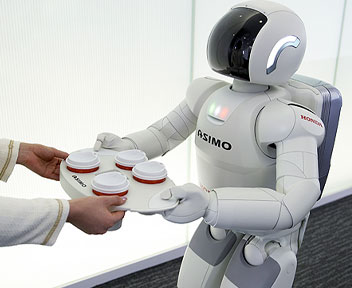
You’ve got served…by ASIMO (from “World of Houg” blog)
4. Japan is good at “borrowing” other countries’ stuff and claiming it as their own. Sometimes, they make it better. For instance, bread is actually a commonality to the Japanese grocery store, unlike what Western people tend to believe that Japan is a non-bread country. In actuality, bread is done better in Japan than in the United States. (Of course, this is my personal opinion, but there’s a sure reason to not hate Japanese bread). The bread is soft and moist, and some breads are thick–perfect for sandwiches or even homemade burgers. Sometimes, Japan borrows foreign food and makes them, well, not as good. The ever-popular taco rice from Okinawa comes from, you guessed it, tacos of Mexican descent. Taco rice is made with ground beef and seasonings that you can find underneath “taco seasonings” from the El Paso brand. The beef goes on top of tomatoes, lettuce, and rice. It’s just as it sounds, and if you’re an avid taco-eater like I am, you’ll definitely want real Mexican food to wash it down. Then there’s curry rice, commonly called kare (カレー). For people who like Indian curry, it doesn’t have a lot of spice, but as a Japanese food, it tastes pretty good without the spicy burn.

Japanese Curry Rice (from the “Closet Cooking” blog)
Share this:

The Living Sea – Dragons in the Water
Sleeping on the boat ride over to Kudaka Island, a tiny island several miles from the southern shore of Okinawa, felt like a waste of a perfectly peaceful morning. From the emerald green mountains that loomed in the distance to the rolling blue sea immediately beneath the boat, the sight was worth more than a few extra snores. The sea itself amazed me. It looked like a living thing, the sea, with every tiny depression appearing closer to an azure dragon’s skin. It swelled and fell, breathing, waiting for something to challenge it before it broke white, hungry waves over everything in its path.
I suddenly understood why people strove tirelessly to protect the sea. When you look at it with keen, clear eyes, the sea is just as alive as humans are. Pushing garbage into it is the equivalent to forking rotting food into our mouths. And though humans can dispose of any poisonous morsels, the damage can’t be undone. The beautiful sea is the same way. Trash builds up on the shoreline and the sea creatures within its belly suffer. Ironically, at the end, we humans pay the penalty for our inconsideration. The infected sea creatures, like shrimp, calamari, and fish, go straight into our mouths, and the beaches our children delight in cannot grant them love anymore.
But, if humans with seeking eyes, take a boat ride–any boat ride–over the sea, they will understand its distress. After all, the sea is an extension of life.
Share this:
Super Saiyin Soda
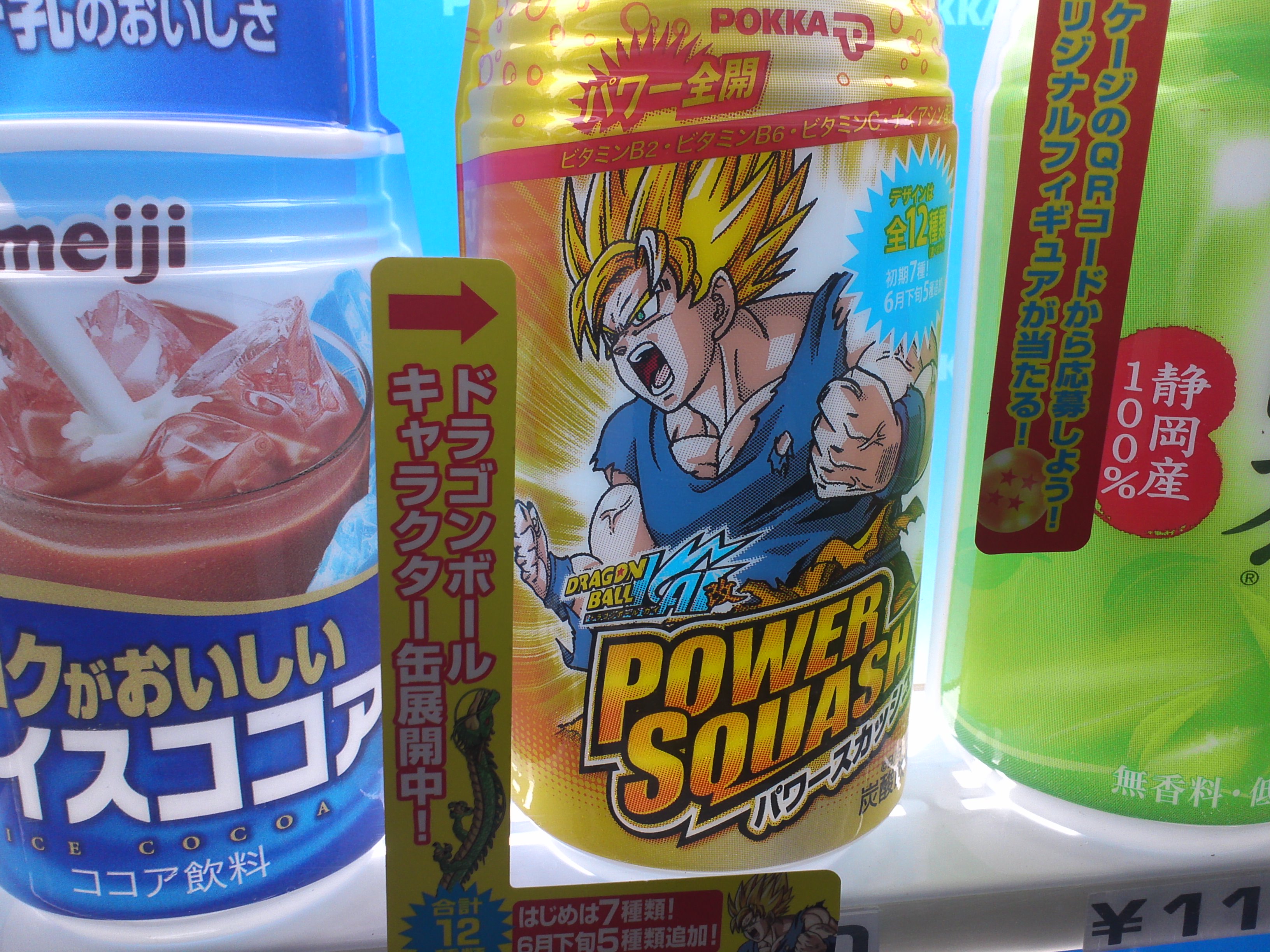
I’ve said it before–characters and mascots are a common aspect of Japan. There are few places where you won’t find an insanely cute mascot describing some easy instructions or a popular anime character showing off on a special edition candy wrapper.
I found this new Dragon Ball Z drink on one of the innumerable amount of beverage vending machines in my city. Goku, who is popular character in the US and Japan, goes Super Saiyin on a can of soda called Power Squash worth less than a dollar. Even the drink’s name is appropriate for Goku.
Share this:

3 Things to Notice While living in Japan
Another list about living in Japan, narrowed down to three things.
1. You’ll see foreign men with Japanese women, but not so much Japanese men with foreign women. I don’t know the exact reason, but there are many half-Japanese kids I’ve met with foreign dads. Maybe it has something to do with the ratio of men to woman, or if Americanized imports, like Hollywood movies and Disney fairy tales, play any role in these couples, but there’s a stereotype that foreign men will do chores. Every foreign bachelor who comes to Japan will have a Japanese girlfriend within a few months. (Just look at the 2010 movie make of the popular My Darling is a Foreigner manga!) But for foreign bachelorettes, it’s not the same. The way that Japanese culture is set up doesn’t support Japanese men–who are used to being served first–to be with a foreign woman–who is more likely to see everyone as equals, especially if they are from the Western world. There isn’t much space for outright opinions, which is a stereotype towards foreign women.
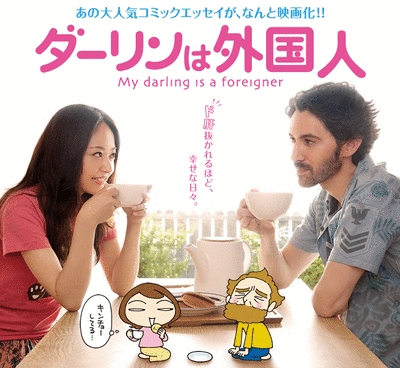
My Darling is a Foreigner from icollectmovieshq.blogspot.com
2. You get more for your buck…er, I mean, yen. The quality is better, but so is what you can get. At the convenience store, I can buy breakfast for my husband and I for under five hundred yen. There are already prepared dinners–not the frozen kind– for sale at the supermarket that can feed a small family of four for around a thousand yen (less than $10). And if you like to drink, there’s all-you-can-drink specials for around eight hundred yen. Even car insurance is reasonable and you can easily customize your coverage. It may seem expensive to live in Japan, but the actual value and quality gives a lot of worth.
3. Characters and mascots are everywhere. All products have cute or appealing characters to entice buyers or explain instructions. My students even like putting popular characters to represent their class banners.
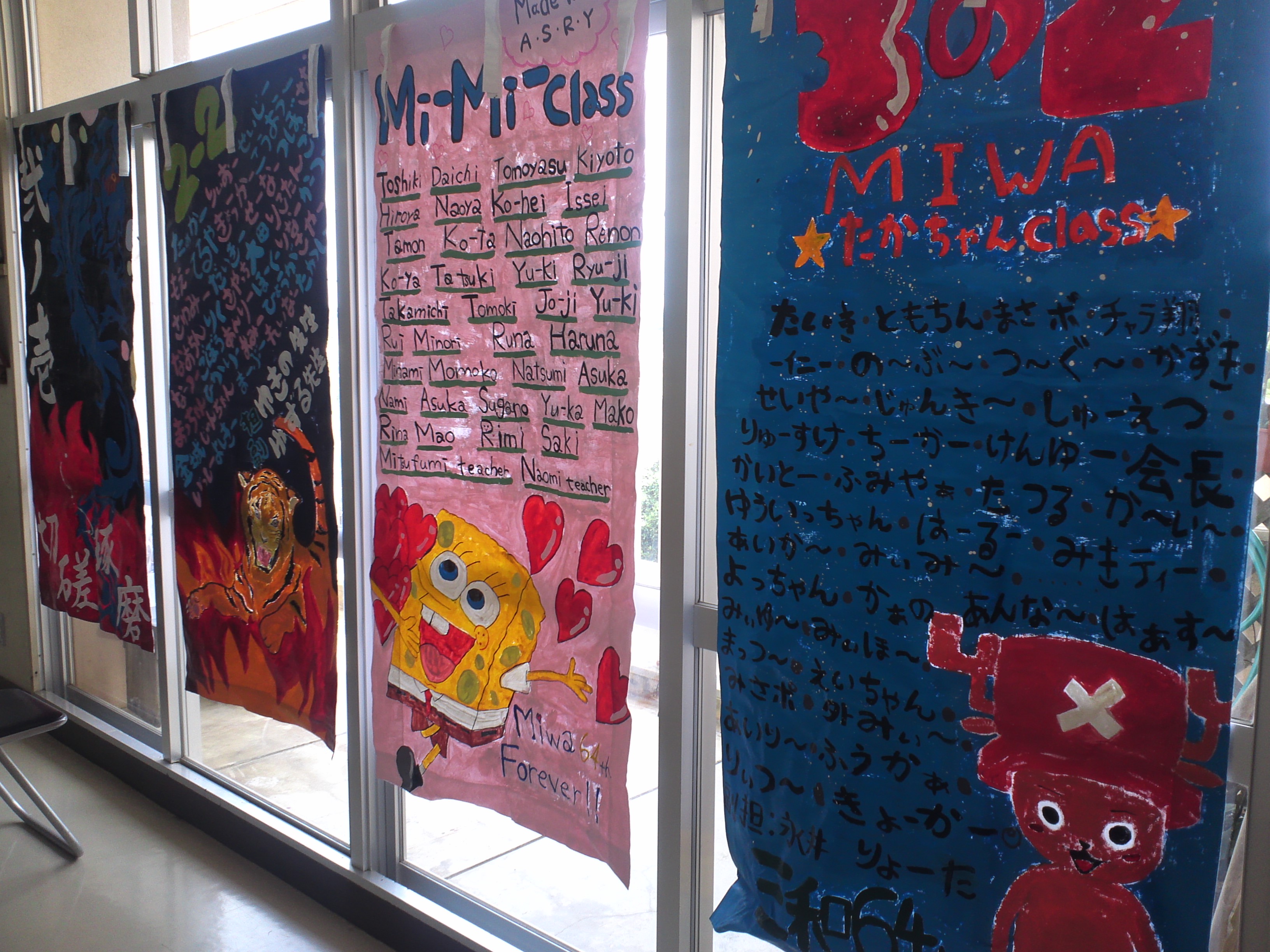
Mascots on my students' class banners (Chopper from ONE PIECE, SpongeBob, and Tigers)
Share this:

5 Things to Think About in Japan – The Downer Edition
Since I’ve been doing a lot of lists about things in Japan that might not be known by the people in my home country, I’ve decided to do a more thoughtful list. But, this list isn’t as happy-go-lucky as the other ones, so be prepared to think and wonder.
1. Japan has a lot of nice countrymen–so nice, that the usual codes don’t feel like discrimination. I’ve read stories of foreigners in Japan being turned away from clubs, bars, and other places because they aren’t Japanese. For those who don’t know Japanese, you probably won’t understand the situation until someone points it out. For others who do and have learned Japanese culture and code, it will always be a shock and disappointment. I’ve learned that Japan can still have close-minded people or methods. For example, when I went to open a bank account, the bank requested that a letter of employment from me–and the person who I went with was a bit angry. “That’s discrimination,” he pointed out later, and I didn’t understand until he told me that this was his first time hearing this and he’s helped many people open bank accounts in Japan. Another example happened more recently. My husband and I decided to check out a nearby bar that had pool. Right when we walked in, a bartender stopped us and kindly stated, “You must have a member’s card.” We were refused before ordering a drink. Everyone else in the bar was Japanese. This event also happened to some ALTs on mainland Japan, who noted it in a JET writing contest, the code of having a “member’s card” or being a “VIP” as the same thing. So, before anyone thinks that Japan is a quiet haven free of stereotypes and discrimination, remember that Japan was once closed to the rest of the world for several decades.
2. The quality of service in Japan is one that makes Western countries pale in comparison–or is it? In the United States, everyone expects McDonald’s hamburgers to be slapped together without a care, or other people to ignore you when you’re in a state of need. In Japan, it’s a little different. Food is made with more care, presents can be wrapped at any store, and people generally help you out when you look like you need help. My husband made a great point when he looked around with fresher eyes than myself; “Is it because the quality in Japan is so good, or is it because the quality in my home country is so bad?” My answer would be the latter. Why? Individualism has to have sacrifices, and one of them is human decency. The mantra, “Think of yourself! Buy for yourself! Be yourself!” rings more strongly than “Think of others! Buy for others! Be kind to others!”
3. Image is too important. When I went to a soccer match for one of my schools, all of the students that weren’t involved in the sports had to go to the match to cheer on their school. I sat there with my students–and became immediately bored and disgruntled. Why were these kids sitting in the hot, sweltering sun in these thick uniforms? Most of them were digging in the dirt or trying to stay cool. They weren’t even paying attention to the soccer match, and some teachers lectured them about it. What’s the point of dragging these kids to “cheer on” their school if they don’t want to? To form a stronger bond with their school’s team when the players don’t even realize they’re there? Or is it really just about images, like the image that there’s so many people to support you because there’s bodies in the stands? This is something to see in every aspect of Japanese life, too. Going to a nomikai, or a drinking party, is attended by a whole office to reinforce bonds for working. A non-drinker could feel left out, so why should they go? For an evening of watching other people get drunk? Or is it image again, the image that there’s unity amongst the office workers who really don’t know each other?
4. Everyone does everything hard–school, work, and playing. Students start studying rigorously for exams in junior high school. Adults work well past 5pm–sometimes until 8 or 9pm–just to complete a report. Additionally, adults can party hard in Japan. Lined on every street, there are armies of izakaya, or bars. Some you can recognize simply by the red lanterns glowing outside of their doors. Others are openly advertised with 100-yen beers on banners. Many adults go to these bars, drink until they’re drunk, stumble onto another bar, drink, maybe go to a karaoke place or bowling, then go back to drinking. And this can happen on any given night, most of the time, immediately after that 10-hour or more job. It’s really common to see a salaryman stumbling through the streets drunk. But does all this de-stress people, or does it add to the stress? It’s not like their livers are getting any better at filtering beer, work, or studying.
5. As a teacher, there is another close-mindedness that extends beyond the classroom. Many people just assume that as a foreigner, you don’t speak Japanese. For example, in meeting my husband’s school principal, he could introduce himself in English very well. Then, he looked at the Japanese librarian and said in Japanese, “She’s cute.” I said to him in Japanese, “Thank you,” and his eyebrows went up in surprise. In class, it’s fine if the students struggle a little bit to find the English word–they’re studying the language and every bit of practice can help them on their tests and in the real world. But as an adult, it’s somewhat sightly to see the internal struggle. Just say it in Japanese, and if I don’t understand, it’s not a big deal. Gestures work too. English, or any other language that’s learned, doesn’t have to be perfect. This is where students and people get in an unnecessary panic. I, as a native English speaker, simply just appreciate the willingness to try to communicate in English.
Share this:
6 More Things to Learn When Living in Japan
Here are a few more things to learn when you’re a foreigner living in Japan:
1. Everyone loves to say “kawaii” (cute), “kakkoi” (cool), or “ikemen” (slang – cool or hot) whenever you wear, say, or do something interesting. It seems that Japanese people are always watching you, especially when you’re a newcomer. If you’re new to an office or school, people will notice even the smallest things about you, like your hair, earrings, bracelets, watches, or clothing. It’s a little more daunting if you’re not used to being watched, but for teachers like me, it’s a good conversation starter in English.
2. You’ll get invited to everything. Whether the invitation is from other foreigners or from Japanese people, there is a need for everyone to invite you to every event taking place in the city. For foreigners, it’s just another chance to hang out with part of the 4%-foreigner statistic in Japan. For Japanese people, it’s a way of showing off their culture that most foreigners would be unaware of.
3. If you know how to use chopsticks, you’ll get comments wherever you go. Because there’s this misconception that foreigners don’t know how to use chopsticks, if Japanese people see a foreigner eating with them, they’ll point out in Japanese, “You use chopsticks very well.” If you come to Japan to work or teach, you’ll hear that incessantly. It’s just a way for Japanese people to get to know you. (For me, I tell them that I’ve used chopsticks since I was in high school because I knew I would come to Japan one day.)
4. It’s hard to get anywhere with “maybe”. It’s more of a cultural thing than foreigners realize. In the United States, “maybe” means that you’re considering something, but there is no clear-cut “yes” or “no”. If you say “maybe” when talking to a colleague in Japan, unless they’ve lived in a Western country before, most Japanese people will take it as a “yes”. Also, most students don’t learn the word “maybe” until they’re in senior high school, so using it freely in a conversation with junior high schoolers and elementary school students will get you confused stares. Be careful about saying “maybe” when someone invites you to an event you don’t want to go to. They’ll be expecting you to show up!
5. Customer service runs really high in Japan. Even if you’re a customer in a McDonald’s, you won’t find customer service like that in Japan. Being a foreigner who hasn’t studied Japanese, going to a fast-food place can be a little scary because everything is written in Japanese. However, most places in Okinawa has an English, Korean, Chinese, and/or Spanish menu ready for foreigners. There are some restaurants on mainland Japan where the menus have Japanese with English translations. Aside from language, places like airports are really impressive with customer service, though they must be strict with the rules. Recently when my husband and I were at Haneda Airport looking for their popular roll cake, a worker told me that they didn’t have it at their shop, but she called around to find which shop had the roll cake. She directed us and when we arrived, the other worker was ready with roll cake in spite having to close in that last few minutes.
6. Advertised food actually looks like the pictures. More than likely, when you order something, the food actually looks like the pictures. It’s not just slapped together like someone didn’t care. There isn’t too much of anything on it (unless you’re a picky type). Just right.

Mega Burgers (2007) from McDonald's (source: supersizedmeals.com)
Share this:

Architecture Doesn’t Have Feelings
Though most foreigners think that Japan only has pagodas and deep-red architecture, the building landscape is different than what you see in anime (manga is a little more realistic but only by a slight margin). Actually,pagodas are influences from China.
Many buildings are really old and damaged-looking. They are built to last for a long time. Some apartments are built with the ground floor as the parking lot while the rest of the building is supported only by pillars or columns. I suspect that these kind of buildings are remnants of Japan’s earlier days when the nomads began to settle and more permanent settlements began. The buildings were similar, except the purpose: to protect food stores. But it’s funny to see these things still around after several hundreds of years.
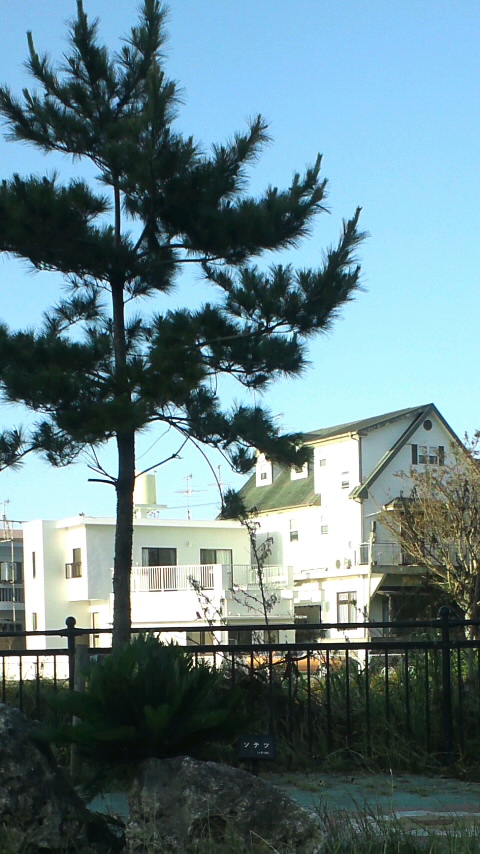
I live in Okinawa, so you are more likely to find some non-Japanese architecture, like the old house in the picture.
Share this:

Typhoon Cuisine: Mmmm, Poisonous!
My husband and I took a spontaneous trip to a nearby beach a day after the type 4 (out of 5) typhoon. As we walked through the debris of trees from the night before, we found a few dead fish on the shoreline. One was a small flounder fish, but one fish was blue with spots. “It’s a pufferfish!” my husband exclaimed upon closer inspection.
Pufferfish, or fugu, is notorious in Japanese cuisine for its poison. Chefs take around 7 years to learn how to properly remove the poisonous parts of the fish without contaminating the meat. It’s normally served as sashimi (raw fish) or chirinabe. The liver, which is where the poison exists, was banned from being served in restaurants in Japan in 1984.


Live fugu fish
Share this:

10 Things to Learn from Living in Japan
Being an English teacher in Japan, I’ve learned a few things from living in the Land of the Rising Sun that you can’t learn from Japanese anime, manga, or video games.
1. The students and people aren’t like the characters from anime, manga, and video games. You won’t see anyone carrying a samurai sword or wearing ninja costumes randomly on the streets. It’s more likely you’ll see a non-Japanese person wear these things than a Japanese person.

Tiny White Fish (from "A box of kitchen" blog)
2. Watch out what you eat! If you are allergic to anything or you specifically can’t eat anything, you’ll have to state it before they give it to you, or come prepared. My husband hates these tiny white fishes that have black eyes. They don’t have tails when you eat them, so they look like worms. He absolutely can’t eat them, and when he finds that his rice and soup is mixed with them, he can’t eat it. My thing, like many non-Japanese people, is natto, which is a type of sticky bean produced opposite of miso. Either way, just be prepared to eat some unusual meals!
3. Don’t be a vegan and come to Japan. Many teachers I’ve met who are vegan have it hard in Japan. In general, Japanese food is loaded with veggies, but they also coat things in some type of animal-derived sauce or soup. Miso soup, for instance, is from a bean paste, but it uses a type of pork stock. In Okinawa, it’s especially hard to be a vegan because the diet has influences from China, Korea, and the United States, so instead of the conventional boiled egg, the egg will have a ball of meat in the middle and coated to be fried.
4. English classics are easy to find. If you’re looking for some English literature, like Uncle Tom’s Cabin, How to Kill a Mockingbird, and books of those caliber, you can find them at the local bookstores. Most likely, they’ll be a bilingual edition or have complicated English words translated into Japanese. A lot of the time, these bilingual editions are for students wanting to study for their eiken exams or college entrance exams, but you can utilize them just for some leisurely reading.
5. Make friends with people in military places. There are things that you’ll miss from your home country, and the best place to get them without paying an arm and a leg through Amazon or eBay is at the military base. Some military folks are just so happy to see another non-Japanese person, they’ll befriend you rather easily and allow you to go onto base with them. Of course, this mostly applies to people in Okinawa where military bases are as common as sushi restaurants, but if you happen to come across someone in mainland Japan, utilize that resource!
6. If you’re going to stay in Japan for a while, learn some Japanese before you get to Japan. If you’re in your home country and you can learn Japanese, take advantage of it. Getting a Japanese tutor or taking JSL, or Japanese as a Second Language, courses can get expensive and time-consuming. Plus, in your home country, learning Japanese can be more comfortable in your usual atmosphere than in a foreign one. This is one of my pet peeves, since many teachers from the JET Programme are sent Japanese books to self-study before arriving in Japan. However useful these books are, most JET teachers don’t even study them, yet, they complain about not being able to understand anything. Even knowing things like “My name is…” and “Please wait” are extremely helpful to both you and the Japanese folks you’re communicating with. Let’s avoid the frustration and crack open the books!
7. Presentation, plastic, and packaging will be everywhere. In Japan, a lot of things are based off of presentation. For example, burgers at McDonald’s actually look like the pictures that are advertised. Part of looking good is the packaging. And within the packaging is the plastic. You’ll find that even cookies will be individually wrapped. Sometimes, things like onigiri, or a rice ball, will have arrows showing how to unwrap it. It’s amazing at first–everything is because you’re in Japan!–but after a while, it’s like, “Oh, it’s individually wrapped…again.” Shrink wrap should just be for CDs.
8. Though there are anime and manga advocating giant robots and mecha, Japan isn’t as technologically-advanced as everyone thinks. Sure, there are hyper-fast bullet trains, and yes, the cell phones are practically hand-held computers now. But just because there are more gadgets doesn’t mean that there are cars or cell phones ready to transform into some type of freedom fighter.
9. Respect for the environment beats out any green movement. For the 1964 Summer Olympics, Japan built a stadium in Tokyo. For every tree that was displaced by the building, a tree was planted somewhere else. Even things like trash day is a way to preserve the environment. Cans, bottles, and newspapers are separated. Even milk cartons are unfolded and recycled. Schools reuse copier paper packages for re-packaging leftover school milks. Tissue boxes are converted into sanitary napkin holders. Everything has the ability to be reused or recycled in Japan, so be weary of just throwing things out. They still have life!
 10. Everyone follows the rules. When the pedestrian light turns red, people don’t cross–even if there are no cars and the distance to the other side is merely a few steps away. Of course, there are a few stranglers who influence the others, but mostly, everyone follows the rules and stays put.
Share this:

Art Helps More than Science
I graduated school as a double-major in art and sports medicine. Even though I spent most of my time doing my science work while art took a backseat, I don’t use science in the real world. As an English teacher, I don’t even need science-but I use my art training every day.
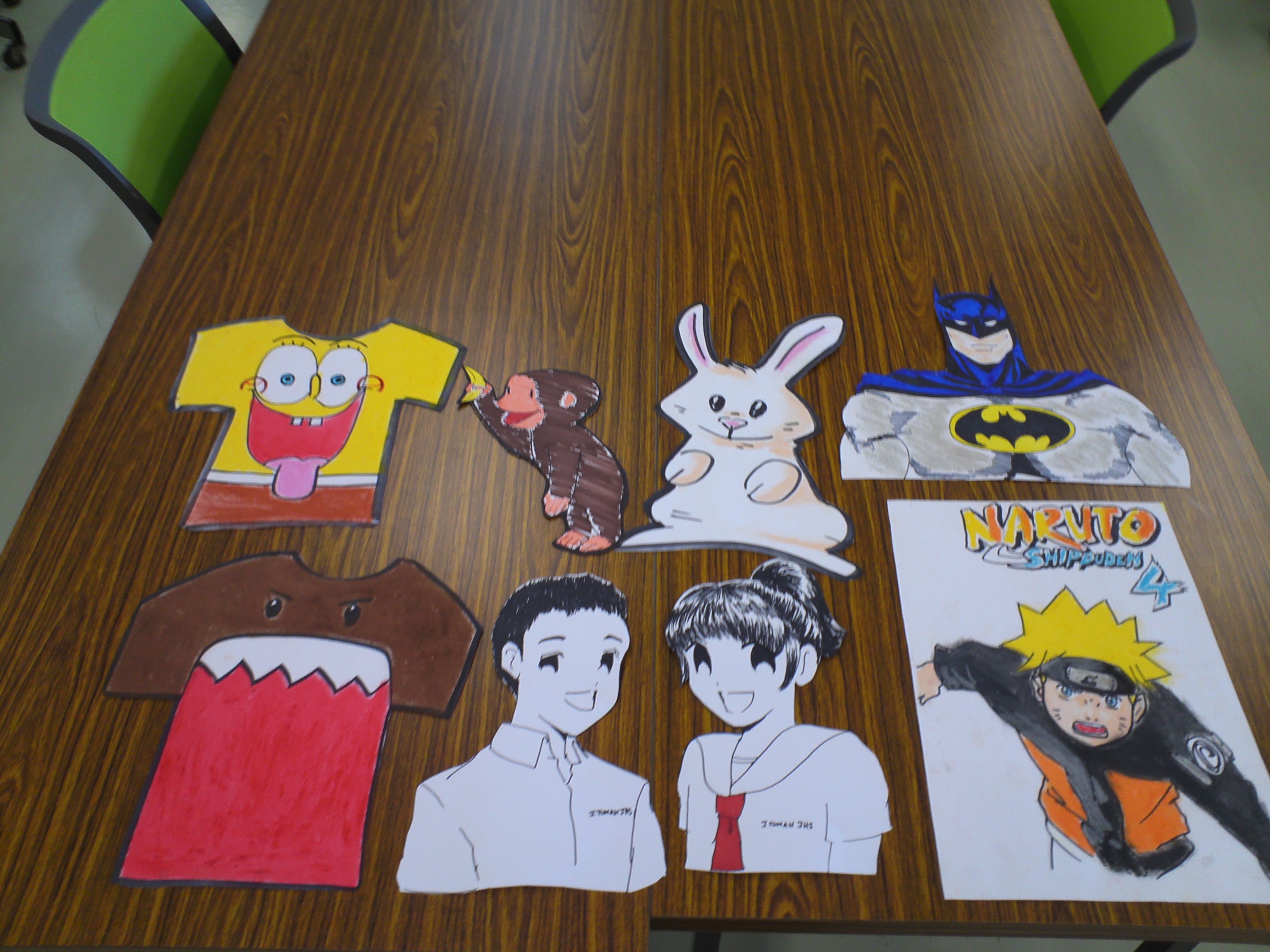
It’s not the ability to draw, as shown below, that makes art an asset in my life. Art goes beyond skill and touches the mind or the heart. In the mind, you learn how to create, dismantle, and improve all aspects of creativity within nature. It doesn’t have to be drawing, painting or sculpting, because creativity and creation don’t come from those skills. They’re a result, a way to combine two ideas together.
I use this kind of creativity to include culture and art into the lessons I help teach in Japan. The visual element peaks students’ interest and the characters become a reference point for students.
The images below are pieces I drew for one lesson, but I ended up drawing four more images for another lesson. “Are you a rabbit?”
“No, I am not.”
Being able to use art to teach “Are you…” makes me happy that I majored in something other than science.
Share this:

Engrish: Toyota Car
YOU’VE GOTTA LOVE ENGRISH.
In Japan, there’s a lot of products that have English, but it’s terribly wrong or incoherent. (The Western equivalent is getting incorrect kanji tattoed on the skin.)
Still, I, like my husband and the people running http://www.engrish.com, love to read Engrish. Here is a Toyota with an Engrish statement. I caught this on my way home.

Share this:

Jd by the Shore

The green on the rocks are algae.
Ok, so no, I didn’t go to enter some odd-ball place opened by a big rock like in Murakami’s Kafka by the Shore, but my husband and I went for a spontaneous drive around Senaga Island. It’s really beautiful with ocean water surrounding the small island. Many locals visit just to look out at the sea.
In the distance lies the city of Itoman. It’s funny how in Japan, you can find a sprawling area of apartments and concrete buildings then look over and find a gorgeous view of the ocean. When you’re able to see this every day, the United States seems like it’s behind. Japan makes it easy to integrate nature and man-made structures, creating a harmonious atmosphere with the natural world. I wish that the United States could learn that co-existing, not crushing, what is natural–whether it’s the sea, the forests, or the people–can be a beautiful thing, like sitting on the edge of this shore.
Share this:

Hello, Mr. Shisa. Thanks for being a Guardian
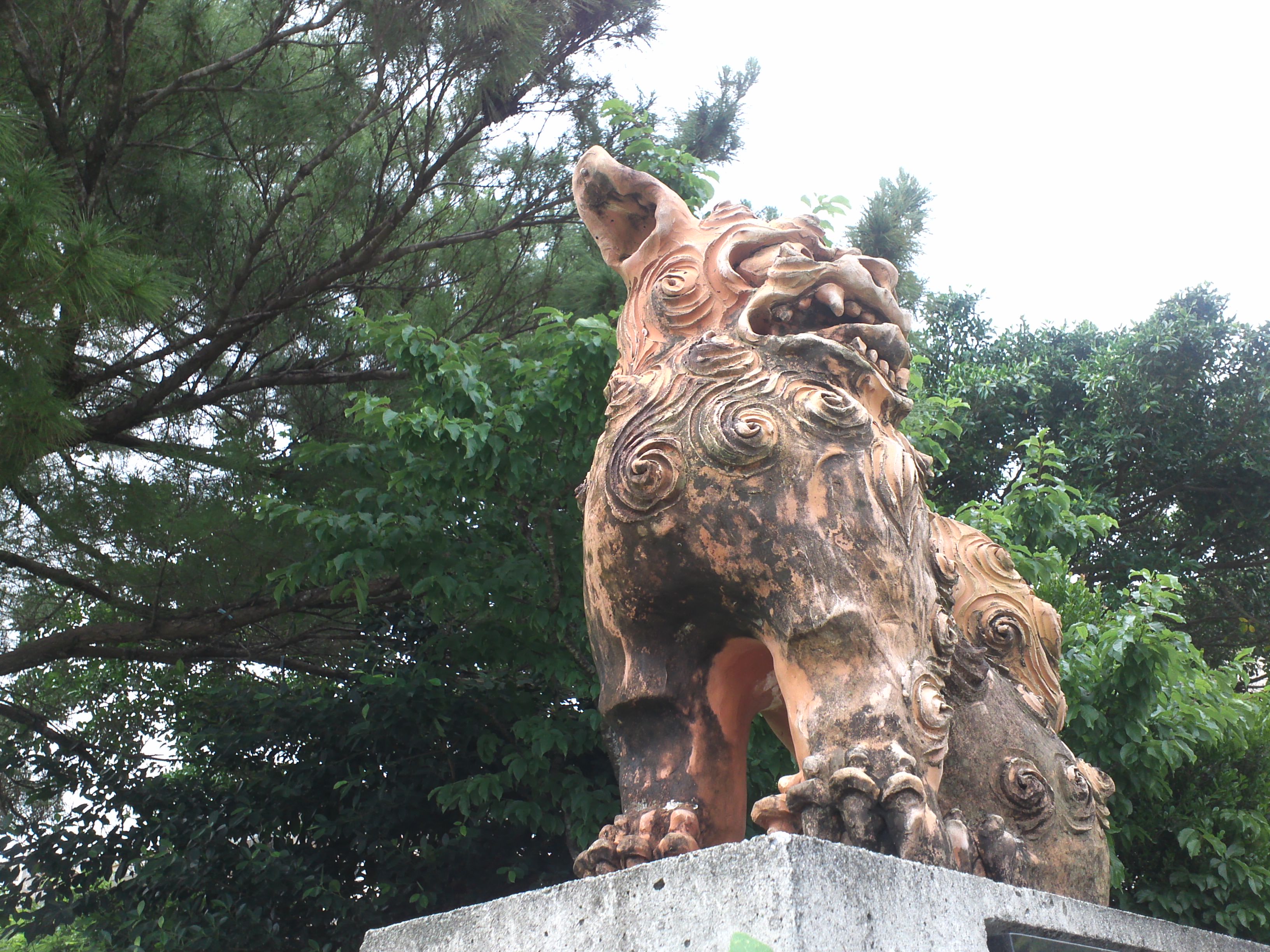
In Okinawa, there are these lion-dog looking beasts on every building. These are shisas, the guardians of Okinawa. Supposedly, they come from China, like many foods here.
The male shisas have their big jaws open, their teeth showing as in a half-growl to scare evil from the building. The female shisas have closed mouths, keeping all the good things from escaping the building. Everywhere, one male shisa and one female shisa work in unison to maintain peace and harmony in the home.
Of course, I don’t know how much of it is true. A local told me this with a strong sense of pride for the Okinawa lifestyle.
Share this:

Gloomy Day, Sunny Plants
It’s raining pretty badly here in Okinawa. Much like San Diego, Okinawa’s rainy season hits around April or May, so the umbrellas have to come out. It gets pretty muggy (but if you say that to an Okinawan, magi (マギ) means “big” in Okinawan dialect). The dark clouds roll around and the gloom just settles into each class. But when I see flowers as beautiful as the one in the picture, I feel a little more happy. Though places as warm and tropical as Okinawa exist, when their brightness is lacking, a small piece of sun is all you need to warm up.

Share this:

Experiment Bleach
Experimenting with using watered down black acrylic paint for a simple Bleach sketch. I gave it to a 3年生, or third year student (9th grader), at the school I work at, and he freaked out! When I handed it to him, a whole bunch of his classmates surrounded him to look at it. When English class started, the folder got circulated around silently before he placed it on his desk and admired it for most of English class. When class ended, he held up the folder with both hands, went around class trying to figure out if he should post it somewhere, then returned to me and said “Thank you” in Japanese. He went back outside, showed some more students, then came back to me and repeated “Thank you” before showing some more kids. I was really surprised by his reaction, but I was also glad that he liked it so much!

Share this:

There’s Strange Kamaboko in the Window!
In Odawara, there’s tons of shops with their signature kamaboko (かまぼこ), or fish cake. If you’ve ever eaten or seen naruto (not the blond heathen from the series) in real ramen dishes, kamaboko has a similar texture and taste. A real fishy taste, like a sweetened fish was added to its smooth but firm existence. Most of the time, kamaboko is the half the shape of a circle with a pink outer layer and a white inner layer. When I showed this image to my co-workers, they were impressed to see the various shapes and colors of these kamaboko.

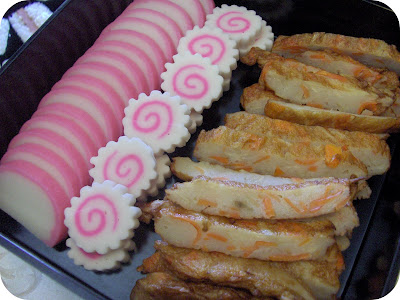
The usual kamaboko with naruto (Picture from zakkalife.blogspot.com)
Share this:

Spring has Come, and so has Allergies
I don’t have allergies, but my husband does, so this year, when I thought he would be the only one sneezing and hacking, I found myself having allergies as well. What the heck, Spring?
Recently, we found out that we weren’t the only sniffling sneezers around. Every minute, we could hear another tenant in our sea-breezed apartment either sneeze or cough. Even with a nice ocean breeze, we all have bad allergies, even people who don’t get allergies. What the heck, Spring?
It turns out that this year is the worst year of allergies. With the rise of global warming, winters become shorter and springs get longer, so flowers produce more pollen earlier. The pollen and increased heat from global warming combined can cause any non-allergic people to start sneezing.
The best way to overcome allergies is to use an AC in your home, drink a lot of water, wear cold masks, and if needed, take an allergy-fighting medicine (beware of medicines that cause drowsiness). If your eyes swell or become itchy, using a piece of ice wrapped in a paper towel or refrigerated teabags can reduced the swelling and redness. For the nose, put some lotion or moisturizer on it to keep it from drying out and becoming painful. And, in all cases, keep boxes of tissues nearby. It’ll come in handy!

Share this:

Pasta in Odawara
I love pasta! It’s one of my most favorite foods, so I eat it a lot. When we went to Odawara, my husband told my friend a story about how I disliked a pasta dish at Eastlake’s Cheesecake Factory. The noodles were undercooked and the seasonings weren’t mixed together in a flavorful way. I had it sent back twice, and in the end, the dish was the same.
Somehow, I was marked as being a princess. I mean, if I was paying $10 for plate of pasta AND had to wait nearly 30 minutes for it to be made, don’t you think it should be a great plate of pasta?
So, my husband embellished the story-as he does with every anecdote-and made my Odawara friend believe that I would hurl the plate of pasta from Odawara Station’s Excelsior Cafe into someone’s face if it wasn’t good enough.
The pasta was ok, leaning toward good. I really liked the flavor of the sauce, but the seasonings didn’t completely meld together. Still, it was cheap and fast and presented well. If I’m going to pay around $10 for a plate, it shouldn’t be bad or slow. I mean, it’s pasta!


 Jade's Escape