This is my cat before she does something bad.


This is my cat before she does something bad.

I always thought that the way manga and anime depicted Valentine’s Day–with girls making chocolate and confessing their hidden feelings to a boy–wasn’t a truedepiction of the day in Japan. I was wrong.

I learned about oppai choco, or boobs chocolate. How I got this beautiful, tit-shaped chocolate is amazing to me. One of the Yakuit-brand ladies came to my school to sell healthy Yakuit yogurts and drinks. Because it was Valentine’s Day, they gave all their customers a sa-bisu (“service”) chocolate–the boobs chocolate. The vice principal, the office workers, the teachers, we all received this edible nipple in return for buying healthy food.

At 4 PM, all of the office workers watched the tiny box-of-a-TV. “The baseball game is playing. Okinawa is in the championship,” my co-worker told me as our supervisor adjusted the antennas. The team was Konan High School, the last standing Okinawan team in the 2010 National High School Baseball Summer Tournament. They beat out 46 teams, making Coach Masaru Gakiya the most famous baseball coach in Okinawa.
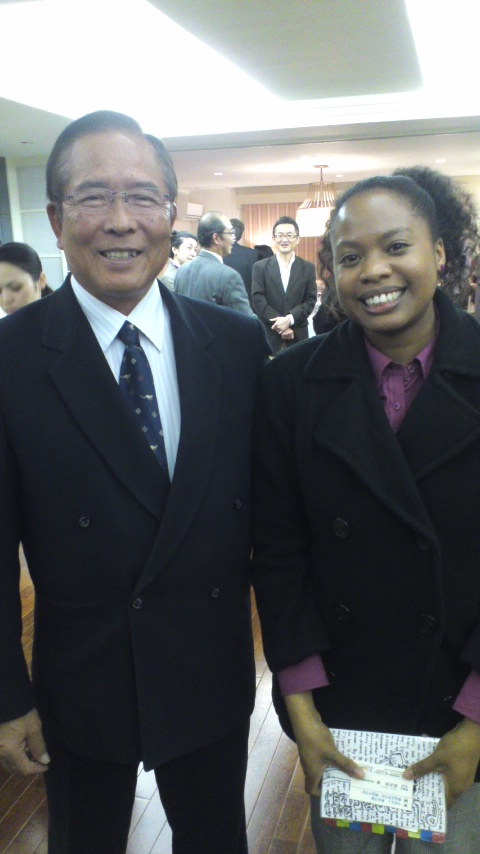
I met him at a private event by the U.S. Consulate, and from all of the Americans present, I think I visibly showed my excitement to be in the same room.

 Hanami, or cherry blossoms viewing, is usually seen throughout Japan in March and April. This year, in Okinawa, the cherry blossoms have bloomed early–but their flowers aren’t as bright as the years before. It’s OK, though. Many festivals in honor of these beautiful, pink flowers have cropped up just as early as the cherry blossoms’ blooming. One festival that my husband and I went to was the Yaese Town Cherry Blossoms Festival.
We arrived in the latter part of the event, but we didn’t miss out on the festivities. After walking up a long hill overlooking Yaese Town and climbing multitudes of stairs (and a kind grandmother commenting loudly, “Mada?” when we encountered another set of stairs), we finally reached the top of the small mountain. The smell of corn dogs, yakisoba (sauteed noodles), and french fries filled the air as music by a local J-rock group sounded from a big stage flanked with large sakura poles.
One thing about festivals that I absolutely love is the festival food. Fatty, greasy, and cheap, festival food can range from traditional Japanese food (soba, ramen, takoyaki) to Western food (tacos, hamburgers, chicken nuggets). This time, there were a few vendors selling cheap vegetables, homemade cookies, and chicken pies.

Aside from the food, the Yaese Town festival had a treat for everyone: a tug-of-war contest. The rope was as thick as my body! It took over twenty people to carry one side of the rope in traditional fashion around the festival grounds. After some (quiet) taunting from both sides, we grabbed the ropes and pulled. It was a hard fight, but the other side managed to pull us over the line. The second time was fruitful: we won in less than five minutes.
We dusted ourselves off, carried the rope again, and then disappeared down the stairs to the cave. It was once used as a medical center for the Okinawans during World War II, and still stands as a historical reminder to all. Many of the elementary school students asked us as we exited the cave area, “Do your pictures have ghosts in them?”
I don’t know if this counts as a ghost; there’s a small circle to the right of my husband. Just so you know, there wasn’t a light inside the cave. We checked.

Per New Year’s and weight gain, I made several resolutions to better my life. For 2013, I have a few, but I’m not just going to say what they are. Many people make that mistake. I want to avoid the talk and just get down to the core of the problem and how to realistically solve them.

Gotta get that fat outta here!!
#1: Lose weight.
Last year, I made this a goal, and in July, I could wear clothes that I hadn’t worn in two years because of my weight. By December, I regained most of the weight I lost five months ago. The most realistic approach to losing weight for me is not stressing out, getting enough sleep, eating more vegetables and fruits, and exercising.
My goal in losing weight this year is 25 pounds. Right now, I weigh 155 pounds–30 pounds over my high school weight–and I want to shed it. This fat represents the stress I’ve gone through since getting married, living in a foreign country without being fluent in the language, and becoming inactive in my local community. The fat needs to go.
My plan is to start with moderate cardiovascular exercises that I enjoy (basketball practice, dance, and jogs) and moderate strength-training regiments at home. I just have to watch my knees (two torn ACL injuries from ten years ago). Right now, my eating habits are OK, but they can be better. I’ll add more dairy products, fruits, and vegetables to my diet from now on.

How to write “learn” in kanji
#2: Learn Japanese.
I’ve come a long way since last year when I could vaguely understand what someone said in Japanese. Now, I’m on my way to becoming a more fluent listener. My goal this year is to become a more fluent speaker. It’s harder than it sounds because I have trouble with what I call the linkers, wa, ga, wo, and ni. I want to master them.
My plan is to study with a native speaker weekly and later take the lowest level of the Japanese Language Proficiency Test (JLPT). Right now, I have a book for passing the JLPT and I have several workbooks for learning the most basic kanji . In the meantime, I’m working on remembering my Japanese speech for a contest.

Bank on the Pig.
#3: Save more money.
That’s all. Just save more money. This past year, I was able to pay off just about all of my credit cards. Now I want to pay off one of two big debts and continue my savings plan for when I return to the U.S. One thing that has kept me in check is a financial planning website called Mint.com, which gives me a pie chart of all of my expenditures and keeps track of my financial goals.

Let’s get to packin’!
#4: Travel more.
My husband and I decided that in 2014, we’ll return the U.S. Before then, I’d like to visit some other nearby countries on holiday breaks. Of course, this could dig into Resolution #3, but we can definitely make it work without having to spend an arm and a leg. Flying between China and Japan starts around $150 dollars. For a new experience in a different land, I’m willing to pay for it.
Once upon a time, there was a writer…
#5: Get to reading and writing!
In August last year, I self-published The Ends Don’t Tie with Bunny Rabbits. Ever since then, I’ve gone on to do a free book-reviewing website by the same name and started to read indie authors’ books. I still have several books on my list, but I’d like to read up to 50 books in 2013. I only read 26 books in 2012 and 24 books in 2011.
With writing, I’d like to start this year with a great Korean comic review for the Manga Bookshelf column. I also want to finish writing another book and get it published this year. It’s possible to do all this if I use my time wisely. No more Youtube time wasters.
Links
1. Scale: http://www.johnstonefitness.com/wp-content/uploads/2012/01/Weighing-Scales-1.jpg
2. “Learn” kanji gif: http://nihongoichibandotcom.files.wordpress.com/2011/04/5b66.gif
3. Piggy bank: http://sj.sunne.ws/files/2011/09/Piggy-Bank1.jpg
4. Suitcase: http://henricodoctors.com/util/images/TravelMedicineSuitcase.jpg
5. Books: https://jadesescape.com/wp-content/uploads/2013/01/books.jpg?w=257

He tapped me on the shoulder after class and pointed at his left loafer with a small smile. “It’s a snake,” the student council president at my Okinawan high school stated, the snake’s tongue slithering happily towards the concrete floor. Although I expected a joke or a chuckle to follow, the student council president ascended the stairs alongside me.
“Can I take a picture of it later?” I asked him, and the English teacher next to me asked him in Japanese. His smile widened, and he replied that it was OK.
Five minutes, I was taking this picture with my cell phone. Even his shoe snake smiled at me.
In my head, I thought, “You’d never see this kind of creativity and loafers on Western shoes.” Of course, there are spikes, but they’re a bit overdone. I’d take these shoes any day.


On a whim, I bought some bread loaves, cheese, beef slices, and green peppers to make some sandwiches for my husband.


When my husband and I shopped in the cat section of a local home improvement shop, this cat caught my eye. Maybe this cat looks like a normal cat in the picture, but he is as tall as my husband’s knee and he weighs 20 pounds–the biggest domestic cat I’ve ever seen in my life! And his asking price was a whopping $2,620!


Good article. If you want to save on tours in English, make friends with the local university students. Most who have an English-related major want practice in English, so they give tours around the city for less money. They just want the speaking experience!
You know, traveling on trains is really convenient, but I wouldn’t sleep on the train if you’re new to the Japanese trains or if you’re traveling alone. Sometimes, you won’t get the chance to sleep because many times, there’s a lot of people on the trains. Take a nap when you’ve got the buddy system going on.
Read the Article at HuffingtonPost


I come from a Filipino family, so lumpia, or eggrolls, are a common item at the dinner. Since I moved to Okinawa, Japan, I haven’t seen any lumpia–or, at least I didn’t think I did. In Okinawa, lumpia is called harumaki (ハルマキ), stuffed with the same fillings (grounded meat, carrots, onions, and seasonings). Despite my twenty-six years of living, I have never made lumpia from start to finish. My nay (“mother” in Tagalog), the master at lumpia in the family, always prepared everything, and my brothers and I would sit down to roll around fifty to a hundred lumpia. Now that I live thousands of miles away, making seemed easier than when my mom had catering deadlines and fundraisers looming over our heads. The lumpia wrappers come in small packs that you can buy at any local store. My husband and I mixed together grounded pork and beef with carrots, onions, green peppers, eggs, pepper, salt, garlic, and basil. I could only go by smell and consistency to make the lumpia before rolled out twenty lumpia and fried them. For our first time making lumpia on our own, they turned out really good.

It’s hard coming across good (and cheap) Mexican food in Japan, even in taco-rice Okinawa. But, if you’re on the look-out like my Mexican husband and I, the ingredients are available to make homemade burritos.

 Although there aren’t any corn flour tortillas floating around in San-A or Marudai, but there are flour tortillas in most cold sections of the grocery stores. Also in the regular grocery stores are: avocados, lettuce, tomatoes, onions, bell peppers, lemons, and meat.

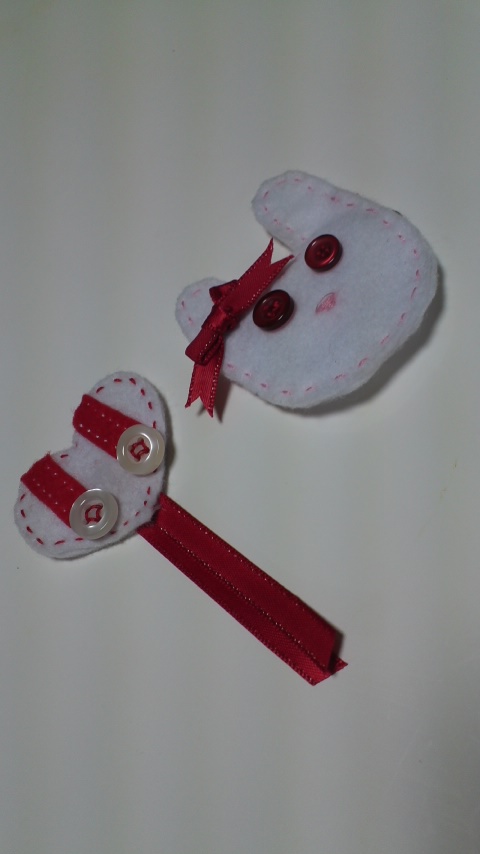
I had some more felt and buttons and made these for a librarian.

Here’s some of the food I made during the weekend.
Per my husband’s request, I made chicken noodle soup.

Chicken noodle soup with bell peppers and onions
We didn’t have any crackers or crunchy things (something my husband always needs during a meal), so I decided to make flour tortilla chips. Normally, tortilla chips are made out of corn tortillas and fried. Unfortunately, the stores in Okinawa mostly have flour tortillas, so I just improvised. Actually, I preferred these chips compared to buying Doritos for nachos. First, I brushed some oil on both sides of the tortillas, sprinkled some salt on them, and cut into pieces before baking them for 5 minutes. The first attempt wasn’t so much a failure but a learning lesson. One minute makes a big different in how good your chips will turn out.

My first attempt at baked flour tortilla chips
My second attempt at flour tortilla chips, and they turned out really good! I added a little bit of guacamole to go with my husband’s brunch of fried eggs and bacon.

Hubby-san’s brunch

My first bingata!

Bingata is a traditional Okinawan dyed cloth made by using stencils and mixed dyes, and dates back to the Ryukyu Kingdom period. The dyeing process takes influence from Javanese, Indian, and Chinese dyeing.
It’s really fun to make, though it’s a bit time-consuming. When I went to do make this bingata bag, the art teacher at my school already finished putting on the stencil outline of different designs on the bags. The brown rice paste, which had hardened into a wax-like substance, held the design, so I didn’t feel weird about painting outside of the lines. I had a little bit of trouble understanding the process through a short Japanese lecture until she visually showed us.
The hardest part about coloring the bingata, especially for non-artists, is putting down the base layer. The base layer is the lightest layer, and if you put in a dark layer first, there is no way of lightening it. If you want a yellow flower with shading, you’d have to paint in the entire flower in yellow first. Once all of the colors have been painted in, the cloth is dried (we used a hair dryer). After drying the cloth, the second layer of painting is added, and it’s more time-consuming than the base layer. I used two different brushes, a regular painting brush and a flat short-bristle brush specifically for dyeing.
This second layer is fun to do, in my opinion. Using the regular brush, I put a dot of color and quickly rub the color in a circular pattern with the other brush. It’s easy to do, but if you have a lot to shade, it takes a little while. Good thing I picked such a small design! Some teachers had trouble doing this part because putting too much paint down wouldn’t shade in the design but completely cover it. Once all of the shades have been made, the design is ironed, and later, washed under cool water for 30 minutes. The rice paste comes off, revealing the actual design (normally flowers, birds, and animals).
It’s good for me to learn about processes like this because I can use these techniques in different mediums.


Your Vote Does Count! (image from http://www.actionnc.org/primary)
As an expat, it’s hard to keep up on events happening in my home country, the U.S. But there are some things that are too important to ignore–like the 2012 Presidential Election.
I know, I know, politics. It’s a nasty word, right? But they affect every person associated with the U.S., whether you’re an American soldier, American citizen aboard, or even the spouse of an American. Deciding who the next president of the U.S. is important. If you haven’t noticed already, the U.S. is tied pretty closely to the rest of the world. When the U.S. economy dived, so did other countries’ economies. People who couldn’t find jobs in the U.S. went to other countries (like my husband and I) to carve out a better life. It’s more important now than ever to vote.
Honestly, I don’t really care who you vote for. The important thing to do is vote. For expats living in Japan, you can check your voter status and sign up for an absentee ballot at http://www.fvap.gov/. Don’t think that a vote won’t change anything. This year, it’ll be a close race, and every vote counts.
If you live in Okinawa, Japan, there are voting assistant days every Friday, from 8:30am-11:30am and 1:00pm-3:00pm at the U.S. Consulate General Naha, Japan Consular Section Waiting Room in Urasoe (2-1-1 Toyama, Urasoe City, Okinawa, 901-2104) (For Google map). Please email NahaVet@state.gov to set up an appointment (no walk-ins).

Now that I’ve completed exactly 2 years in Japan as an English teacher, I feel more accomplished–and less “escaped” from the life in the U.S. I have a great job, a great husband, and an ever-growing confidence in my not-so-new surroundings here in Okinawa.
Looking back on the past year, things have really changed. I earned my Teaching English as a Foreign Language (TEFL) certification, which has made me look at teaching completely differently than when I arrived in Japan 2 years ago. My Japanese has gotten better, and I can hold a conversation using easy language. I’ve even gone from my Japanese study books to reading Japanese comics in their native language (not an easy feat, if you ask me). And finally, I still spend every day playing with my husband (that’s something that hasn’t changed and I still enjoy).
Since this year, I’ve been looking at my future more seriously, more squarely. I’m thinking about things that I’ve always wanted to do, things that I wish I could’ve done, and all that good jazz. But you know, I’ve learned that thinking about things isn’t going to take me anywhere except nowhere. So, just like how I got my butt into shape and made my dream of coming to Japan a reality, I have to get other things in order.
I want to:
*buy a house
*publish a short story book
*lose weight
*help out more with school life
*learn how to play the piano and/or guitar
*improve my Japanese
*learn Spanish
I know I can achieve most, if not all, of these things in a year’s time.

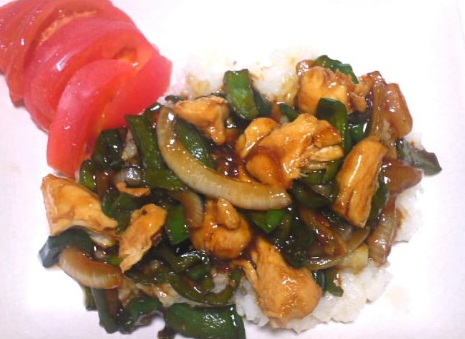 Since I wanted to use up some of the bell peppers slowly warping into leathery skin, I cut a couple with some onions and a slab of boneless chicken fillet before tossing them together in a saucepan of teriyaki sauce. The magic came in with the seasonings, though. I added basil, parsley, garlic, salt, habanero pepper, chili pepper, and grounded pepper until it had a little bit of a kick. Just a tablespoon of soy sauce pulled out some of the teriyaki flavor.
The rice wasn’t regular Japanese white rice, but during the boiling process (surprisingly, I don’t have a rice cooker), I added a chicken bouillon cube. My husband doesn’t like plain white rice anyways.

“Who?”
“You know, CLAMP,” I said excitedly before repeating the name with Japanese pronunciation: “Ku-la-n-pu”. My Japanese co-worker scrunched up his face in the same way my students looked at me whenever I spoke English.
“Who?”
Oh, how I wanted to die. Apparently, he was another Japanese person–who liked manga–who didn’t know the four-member manga group, CLAMP. How could CLAMP, the CLAMP who created Chobits and a dozen other manga titles, the CLAMP who have been awesome guests at Anime Expo, the CLAMP who influenced great artists around the world like Kriss Sison (SevenSeas’ Last Hope), be so unknown among my Japanese co-workers?
I thought that when I came to Japan, CLAMP’s name would be well-known, but sadly, even some of the most ardent manga readers weren’t in the know. The only way I can get recognizing eyebrows to go up is by saying, “They made Card Captor Sakura.” I look on that series with affection; the first volume of CCS was the first manga volume I ever owned, so the CLAMP who got me interested in possessing volumes, and thus, an expensive (outside of Japan) hobby was born.
Come to think of it, CLAMP was the first for a lot of things for me. CLAMP’s Chobits was the first manga series I completely collected and the Magic Knight Rayearth series was the first manga I followed religiously when it was in the throw-back issues of Tokyopop Magazine (before its papery demise). Many of my early drawings were based from studying CLAMP’s work.
What I love about CLAMP is the art style between the three artists, Tsubaki Nekoi, Satsuki Igarashi, and Mokona, and the refreshing writing from the leader, Nanase Ohkawa. The characters are drawn very beautifully and their expressions are spot-on in regards to the writing. Most of the stories have romance in it, but there are more parts of their stories than love (unless you’re reading The One I Love). The consistent elements inside of CLAMP’s stories are magic, endearing characters, relationships, and the child-like adventurous quality from the 1980’s.
From all of their manga I’ve read so far, I think that Clover and Legal Drug (Drug and Drop) are experiments for the artists. In Clover, the expansive negative space in the panels and the minimal dialogue gave a usual story–magical kids are taken into the military to be used as weapons–a completely eerie, sad feeling, one that has resonated in my mind like a heart break. Legal Drug, though typical in story and art style, has only male leads in the entire manga and seems to lead readers towards a close BL style like The Descendants of Darkness and Brother x Brother.
Whenever someone asks me, “What’s your favorite manga?” I always think of a title by CLAMP first. But now that I’ve met another person who’s not familiar with their work, I think I’ll just carry around a picture of Sakura from Card Captor Sakura.
I have decided to start blogging about what I eat so that I can keep track of my diet and how I make things. Lately, I’ve been cooking more at home to help lessen my tummy fat, fatten my wallet, and condition my cooking skills. One of the suggestions I’ve read in losing weight without categorizing calories (something I was guilty of) was by keeping a food blog. It forces me to see what I’m eating and also garners support (or criticism) from people reading about the food I post. In a way, it’s a way to kick my ass into shape. Along with the food blog, I’ve been upping my cardio workouts, switching between dancing, kickboxing, and ballet to keep things interesting. However, I’m looking forward to food blogging. I like cooking for my husband, especially when I can make the meal look and taste good, which is harder than it looks.
Today, I felt like eating a creme pasta with baked chicken, though not the best choice in the healthiest of meals (whip creme is made out of percentage of fat and pasta has carbs). But baking chicken curbs the extra fat from pan-frying and the fresh ingredients give the food a more wholesome taste. Tomorrow, I hope the meal is more healthy. Wish me luck!

Lightly-seasoned baked chicken, creme sauce pasta with fresh basil, and freshly-cut tomatoes and onions
Creme Ingredients:
-1 small carton of whipped creme, liquid
-2 tablespoons of fresh sliced basil
-1 tablespoon of onions
-spaghetti pasta
-2 tablespoons of margarine
These are cheap and local items at any Japanese grocery store or produce place.
First, cook the onions and any other vegetables. Put the cooked veggies to the side. Under low to medium heat, melt the margarine in the pan until the water has evaporated and before the margarine can brown. Pour the whipped creme into the pan and slowly stir the melted margarine with the creme. Let the combination simmer a little before turning down the heat. Stir it for 5 minutes. Add all of the ingredients into the pan and enjoy!

It’s funny to hear anime and manga fans say earnestly, “I want to go to Japan!” Images of giant mecha and tiny Japanese maids follows along with rows and rows of kawaii and strangely adorable fashion. But honestly, that’s tourist stuff.
When anyone who hasn’t learned Japanese enters Japan to live for a long time, the reality sets in: “I’m illiterate!” It’s not like going to Mexico and seeing things remarkably close to English–Ingles is English–but more like dropping into a realm of complicated characters and incoherent yet noble English phrases.
The language barrier is a big obstacle for expats in Japan, especially the ones who have never studied Japanese. Besides romaji, the Romanized Japanese alphabet, non-Japanese-speakers won’t be able to read anything. Foreigners become virtually illiterate. The newspapers, the restaurant menus, even the manga become sources of frustration. “I can’t read!!”
For book worms like myself, it’s been challenging trying to overcome my Japanese illiteracy. In some ways, I’ve had to sacrifice my English literacy to close the gap. Instead of reading books in English, I’ve opted to study Japanese. It took me a month to memorize all of the characters in hiragana followed by another month of remembering all of the characters in katakana. But that’s only the tip of the iceberg. The fourth writing system in Japan is kanji, characters originating from China, and it’s the writing system that adorns stores, food packages, billboards, and signs. No one, even tourists, can’t escape kanji in Japan. It’s everywhere.
And kanji is where the illiteracy begins to take an ugly turn. Kanji has two readings, on-reading and kun-reading. On-reading, or on-yomi, is the Chinese way of reading kanji. Kun-reading, or kun-yomi, uses the pronunciation of the existing native Japanese word. As one of my co-workers explained to me, the way that most people know which reading is which, is by seeing the sequence of the characters. Most of the time, two kanji together gives the words the on-reading, but by themselves, they’re pronounced using the kun-reading. An example is using the kanji for “mother”, 母, pronounced haha in kun-reading. However, if “mother” is coupled with another kanji, 国, or “country”, the pronunciation changes to the on-reading, bokoku (母国), or “mother country”. To be frank, learning kanji is really difficult. Even some Japanese people tell me, “Even some Japanese people don’t know kanji.”
But there’s something endearing about kanji. Maybe it’s because of the difficulty that I’ve grown to accept it not as a hulking obstacle in my life in Japan, but as a part of the culture. I decided to try and learn as much kanji as I possibly can before I return to the United States. Some ways I’ve been slowly acquiring the meanings and readings of kanji is simply by asking my co-workers. “What does this mean? How do you say this?” (And this is where I get the same statement–“Even some Japanese people don’t know kanji.”)
So far, the best way I’ve been learning kanji besides by shameless questions is by reading manga. Some manga use furigana. It’s a small set of kana (hiragana and katakana) that shows the reading of kanji. Furigana is useful for elementary students and Japanese learners. The difference between learning kanji from a kanji practice book and a manga is pretty big. With kanji practice books, there’s little fun in them. Just memorize the stroke order, or how it’s written, and write it over and over again until it becomes second nature. However, manga has a more gratifying result. A story unfolds within each learned kanji, and the practical way that characters are used can easily become imprinted in one’s head. I’m learning Japanese idioms and new words with every manga I read in its original, untranslated form–something that would take years to learn in a Japanese class.
But I’m still a long way from being literate in Japanese, and so is every other foreigner who’s never studied Japanese in Japan. The rows and rows of kawaii can easily turn into rows of kowaii, so tourists and anime fans, beware. Study Japanese before you come to Japan.
 Jade's Escape