
I love my Bombay! I love Adove Illustrator, too, so I had to draw this moment we had today!

I love my Bombay! I love Adove Illustrator, too, so I had to draw this moment we had today!


In black is the old way of writing. In red is what each kanji means.
In today’s class, everyone went to the calligraphy and art classrooms. There were many beautiful calligraphy and art pieces. Some of the art pieces were impressive, so I decided to take a picture of them. Later on, I’d like to try to make a bag calligraphy.

日本語の日誌:
今日の授業に、みんなさんは書道教室と美術教室へ行きました。たくさんの美しな書道も芸術作品がありました。いくつかの芸術作品はとても印象的ですが、私はそれを写真することにしました。後で、鞄に書道を作りてみたいです。
If my Japanese is wrong, please correct me! I’m still learning!

 Just as the States borrowed the hamburger, Christmas trees, and burritos from other countries, Japan has the same tendency. With Valentine’s Day, it’s no exception. But Japan did more than adopt Valentine’s Day into its social holidays; it made White Day (March 14) a secondary Valentine’s Day where only men give chocolates to women. The custom is if a male receives a gift on Valentine’s Day (where only women give gifts to men), the male must return a gift with three times the value of their Valentine’s Day gift.
Last year, most of female teachers at my schools complained about how the male teachers only bought them White Day gifts while they actually gathered together and made Valentine’s Day gifts. This year, the sports club teachers actually made a poor man’s tiramisu (an Italian dessert) consisting of vanilla pudding, graham crackers, and cocoa powder. No complaints from the female teachers. Everyone, including all of the male teachers who didn’t participate in the tiramisu-making, was impressed. On top of the tiramisu, I received a dainty tin can with chocolates from the English department and a small box of Belgium chocolate from the basketball coach. All of the gifts were delicious, so I’m really happy I didn’t take a day off!

 Today, my husband and I went to the Studio Ghibli Layout Exhibition at the Okinawa Prefectural Art Museum. It was so interesting! Hayao Miyazaki made beautiful layouts.

All of the works featured were from Studio Ghibli’s last fifty years. Works as early as Lupin the Third (1971) and Sherlock Hound (1984) stood among more modern works like Ponyo (2010) and Spirited Away (2001). Though exhibition showed many of Miyazaki’s works, other directors under Studio Ghibli also shared the spotlight. Studio Ghibli’s co-founder, Isao Takahata, showcased layouts from My Neighbors the Yamadas (ホーホケキョとなりの山田くん, 1999), Heidi Girl of the Alps (アルプスの少女ハイジ, 1974), and Grave of the Fireflies (火垂るの墓, 1988).

At the end of the exhibition, everyone could make a black-and-white drawing on a sticker and put it on a wall. There were hundreds of stickers on the wall! 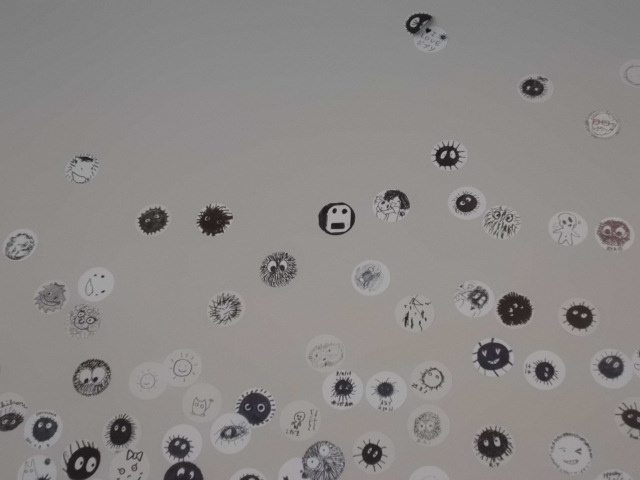
The next Studio Ghibli animations set to come out this year are The Wind is Rising (風立ちぬ) and The Tale of Princess Kaguya (かぐや姫の物語).

My husband’s Blubber Island face and me hugging the kodama from Princess Mononoke
日本語の練習 Diary
今日、夫さんと沖縄県立美術館のスタジオジブリレイアウト展へ行きました。面白かったです!宮﨑 駿さんは美しレイアウトを作りました。私達はスタジオじブリのルーピンやシャーロックハウンドやポニョや千と千尋の神隠しのレイアウトを見えました。去年、スタジオジブリのアニメはかぐや姫の物語や風立ちぬがあります。

Picture of the new anime coming out this year (from Gigazine).


Coming to Japan, I thought English education would be more advanced. What I found was a little disappointing: people who have studied English for ten years couldn’t form an English sentence. Even as more English speakers in Japan come forward as English teachers or translation experts, it’s easy to hear some really strange (and straightforward) English phrases in Japan.
David Sein’s 日本人のヘンな英語 illustrates in manga form the differences between Japanese people’s English and native English.
I think one reason why it’s hard for Japanese people to speak English is that it’s so direct. For instance, if someone says, “本を見ました,” the meaning could be, “I looked at the book” or “I saw the movie” (or if there are legs coming out of the book, “I watched the book”). 見る, or miru, has several meanings: look, see, or watch. Just picking which meaning to use is hard for Japanese speakers.
Sometimes, English idioms are taken quite literally. In English, “I cut the cheese,” isn’t used literally—someone cuts a piece of cheese with a knife—but it’s usually the image in Japanese people’s heads when this phrase is said. English speakers, however, see it as someone busting a stinky, dark cloud from their butts. In the Lang-8 blog, the blogger also noted how Japanese people are taught some strange English from Japanese words. Several words in Japanese aren’t translated very easily into English because its particular to Japanese culture. いただきます, or itadakimasu (literally “I humbly receive”), is a word said before anyone eats a meal in Japan. The meaning of it is lost in translation, especially in English when a person usually says, “Thanks for the food,” or “Let’s eat!”
David Sein’s 日本人のヘンな英語 is available for 1,050 yen on Amazon.co.jp.

When someone has two different personalities, they’re called, “ジキルとハイド,” or “Jekyll and Hyde” in English. Based on the Robert Louis Stevenson’s A Strange Case of Dr. Jekyll and Mr. Hyde, the names have not only been used for dissociative identity disorder in Western culture but also in Japanese culture. To say, “jikiru to haido,” to someone’s face is a little harsh, even if it’s true. (I recently met a teacher who is calm during office hours, but outside of the office, he becomes what teachers have said, “Jekyll and Hyde” or a “monster”.)

There is a manga called ジキルとハイドと裁判員 (Jikiru to Haido to Saiban-in), translated as Jekyll and Hyde and the Citizen Judges (also, the word “saiban-in” can be “jury” or “lay judges”). It still follows some of the original story from the 1886 novella, but it includes a supernatural twist that only Japan can do.

One thing I like about living in Japan: I can read Japanese manga technique books for free. The book I picked up from the school library was Tokyo Institute of Animators’s 思いいどおりのキャラが描けるテクニックBOOK, or Character Technique Book (literally “techniques so that one can draw the expected character”).

Character Technique Book is a 単行本, or tankoubon, meaning “special volume” usually from a series of lectures.

This book’s best aspect: showing how to draw people, weapons, animals, and places from the preliminary sketches to the finished product. Even how to color pictures (digitally and traditionally) is outlined. For all emerging comic artists (and those who can read Japanese), I would recommend this book.
There are also other technique books like this such as Cool Male Characters Technique Book (loose translation of カッコいい男のキャラの描けるテクニックBOOK) and Cute Girl Characters Technique Book (loose translation of かわいい女のキャラの描けるBOOK).
Character Technique Book is available for 1050 yen on Japan’s Amazon website. You can also find this book as How to Draw Manga Character Background Technique Book on Amazon.com for $33.18.

This is my cat before she does something bad.


I always thought that the way manga and anime depicted Valentine’s Day–with girls making chocolate and confessing their hidden feelings to a boy–wasn’t a truedepiction of the day in Japan. I was wrong.

I learned about oppai choco, or boobs chocolate. How I got this beautiful, tit-shaped chocolate is amazing to me. One of the Yakuit-brand ladies came to my school to sell healthy Yakuit yogurts and drinks. Because it was Valentine’s Day, they gave all their customers a sa-bisu (“service”) chocolate–the boobs chocolate. The vice principal, the office workers, the teachers, we all received this edible nipple in return for buying healthy food.

At 4 PM, all of the office workers watched the tiny box-of-a-TV. “The baseball game is playing. Okinawa is in the championship,” my co-worker told me as our supervisor adjusted the antennas. The team was Konan High School, the last standing Okinawan team in the 2010 National High School Baseball Summer Tournament. They beat out 46 teams, making Coach Masaru Gakiya the most famous baseball coach in Okinawa.
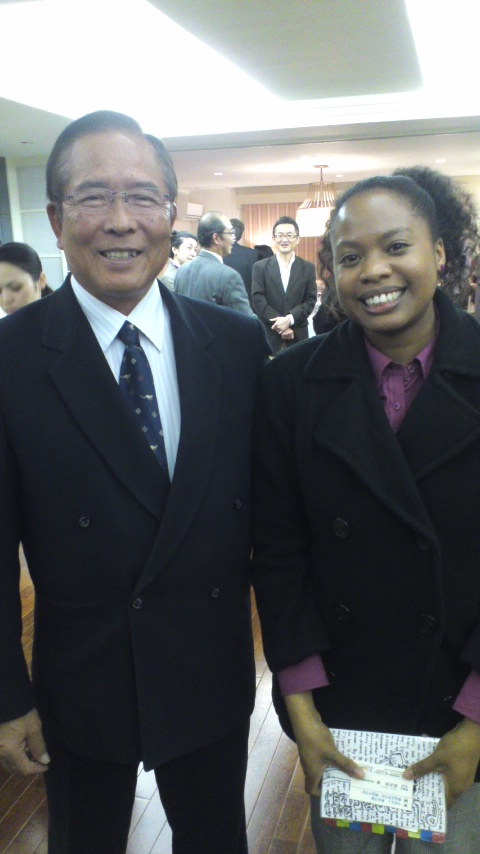
I met him at a private event by the U.S. Consulate, and from all of the Americans present, I think I visibly showed my excitement to be in the same room.

 Hanami, or cherry blossoms viewing, is usually seen throughout Japan in March and April. This year, in Okinawa, the cherry blossoms have bloomed early–but their flowers aren’t as bright as the years before. It’s OK, though. Many festivals in honor of these beautiful, pink flowers have cropped up just as early as the cherry blossoms’ blooming. One festival that my husband and I went to was the Yaese Town Cherry Blossoms Festival.
We arrived in the latter part of the event, but we didn’t miss out on the festivities. After walking up a long hill overlooking Yaese Town and climbing multitudes of stairs (and a kind grandmother commenting loudly, “Mada?” when we encountered another set of stairs), we finally reached the top of the small mountain. The smell of corn dogs, yakisoba (sauteed noodles), and french fries filled the air as music by a local J-rock group sounded from a big stage flanked with large sakura poles.
One thing about festivals that I absolutely love is the festival food. Fatty, greasy, and cheap, festival food can range from traditional Japanese food (soba, ramen, takoyaki) to Western food (tacos, hamburgers, chicken nuggets). This time, there were a few vendors selling cheap vegetables, homemade cookies, and chicken pies.

Aside from the food, the Yaese Town festival had a treat for everyone: a tug-of-war contest. The rope was as thick as my body! It took over twenty people to carry one side of the rope in traditional fashion around the festival grounds. After some (quiet) taunting from both sides, we grabbed the ropes and pulled. It was a hard fight, but the other side managed to pull us over the line. The second time was fruitful: we won in less than five minutes.
We dusted ourselves off, carried the rope again, and then disappeared down the stairs to the cave. It was once used as a medical center for the Okinawans during World War II, and still stands as a historical reminder to all. Many of the elementary school students asked us as we exited the cave area, “Do your pictures have ghosts in them?”
I don’t know if this counts as a ghost; there’s a small circle to the right of my husband. Just so you know, there wasn’t a light inside the cave. We checked.


Ninja at 5 months.
In a post I did three months ago, I put up pictures of my new cat, Ninja “Bear” Galvan. She was only two months old then (according to the vet), but now she’s almost six months. Every time my husband and I pick her up, we say, “重いです,” (or omoi desu) “Heavy.”
Since taking her off the streets of Naha, Ninja has changed in some of her habits but mostly in appearance.
The habits that have changed:
-She sleeps with her eyes closed now. She used to sleep with her eyes open, but we waved our hands over her face, and she didn’t spring to her feet. To me, that’s counter-intuitive.
-She doesn’t eat any kind of food anymore. She only eats Sheba, the most expensive brand of cat food in the cat food aisle. Maybe the black cat on the can swayed her to the Dark Side.
-She doesn’t meow during her baths. She just looks at us with a bored expression. (But she still falls asleep when we towel-dry her.)
-She paws, licks, or bites my face in the morning right before my alarm clock. It’s like she’s saying, “おきて!おきて!食べたい!” (Okite! Okite! Tabetai!) “Wake up! Wake up! I want to eat!”

Ninja enjoying her gaming chair.
-She prefers to sit in my husband’s blue gaming chair when he’s not in it–even if it’s only a few seconds after his butt has left the seat.
-She plays tag and fetch with me.
From all of these things, Ninja has become our precious house cat with a growing stomach and a beautiful coat. I wonder if I’ll turn into one of the crazy Japanese pet owners who give their pets mud baths.

Per New Year’s and weight gain, I made several resolutions to better my life. For 2013, I have a few, but I’m not just going to say what they are. Many people make that mistake. I want to avoid the talk and just get down to the core of the problem and how to realistically solve them.

Gotta get that fat outta here!!
#1: Lose weight.
Last year, I made this a goal, and in July, I could wear clothes that I hadn’t worn in two years because of my weight. By December, I regained most of the weight I lost five months ago. The most realistic approach to losing weight for me is not stressing out, getting enough sleep, eating more vegetables and fruits, and exercising.
My goal in losing weight this year is 25 pounds. Right now, I weigh 155 pounds–30 pounds over my high school weight–and I want to shed it. This fat represents the stress I’ve gone through since getting married, living in a foreign country without being fluent in the language, and becoming inactive in my local community. The fat needs to go.
My plan is to start with moderate cardiovascular exercises that I enjoy (basketball practice, dance, and jogs) and moderate strength-training regiments at home. I just have to watch my knees (two torn ACL injuries from ten years ago). Right now, my eating habits are OK, but they can be better. I’ll add more dairy products, fruits, and vegetables to my diet from now on.

How to write “learn” in kanji
#2: Learn Japanese.
I’ve come a long way since last year when I could vaguely understand what someone said in Japanese. Now, I’m on my way to becoming a more fluent listener. My goal this year is to become a more fluent speaker. It’s harder than it sounds because I have trouble with what I call the linkers, wa, ga, wo, and ni. I want to master them.
My plan is to study with a native speaker weekly and later take the lowest level of the Japanese Language Proficiency Test (JLPT). Right now, I have a book for passing the JLPT and I have several workbooks for learning the most basic kanji . In the meantime, I’m working on remembering my Japanese speech for a contest.

Bank on the Pig.
#3: Save more money.
That’s all. Just save more money. This past year, I was able to pay off just about all of my credit cards. Now I want to pay off one of two big debts and continue my savings plan for when I return to the U.S. One thing that has kept me in check is a financial planning website called Mint.com, which gives me a pie chart of all of my expenditures and keeps track of my financial goals.

Let’s get to packin’!
#4: Travel more.
My husband and I decided that in 2014, we’ll return the U.S. Before then, I’d like to visit some other nearby countries on holiday breaks. Of course, this could dig into Resolution #3, but we can definitely make it work without having to spend an arm and a leg. Flying between China and Japan starts around $150 dollars. For a new experience in a different land, I’m willing to pay for it.

Once upon a time, there was a writer…
#5: Get to reading and writing!
In August last year, I self-published The Ends Don’t Tie with Bunny Rabbits. Ever since then, I’ve gone on to do a free book-reviewing website by the same name and started to read indie authors’ books. I still have several books on my list, but I’d like to read up to 50 books in 2013. I only read 26 books in 2012 and 24 books in 2011.
With writing, I’d like to start this year with a great Korean comic review for the Manga Bookshelf column. I also want to finish writing another book and get it published this year. It’s possible to do all this if I use my time wisely. No more Youtube time wasters.
Links
1. Scale: http://www.johnstonefitness.com/wp-content/uploads/2012/01/Weighing-Scales-1.jpg
2. “Learn” kanji gif: http://nihongoichibandotcom.files.wordpress.com/2011/04/5b66.gif
3. Piggy bank: http://sj.sunne.ws/files/2011/09/Piggy-Bank1.jpg
4. Suitcase: http://henricodoctors.com/util/images/TravelMedicineSuitcase.jpg
5. Books: https://jadesescape.com/wp-content/uploads/2013/01/books.jpg?w=257

He tapped me on the shoulder after class and pointed at his left loafer with a small smile. “It’s a snake,” the student council president at my Okinawan high school stated, the snake’s tongue slithering happily towards the concrete floor. Although I expected a joke or a chuckle to follow, the student council president ascended the stairs alongside me.
“Can I take a picture of it later?” I asked him, and the English teacher next to me asked him in Japanese. His smile widened, and he replied that it was OK.
Five minutes, I was taking this picture with my cell phone. Even his shoe snake smiled at me.
In my head, I thought, “You’d never see this kind of creativity and loafers on Western shoes.” Of course, there are spikes, but they’re a bit overdone. I’d take these shoes any day.


On a whim, I bought some bread loaves, cheese, beef slices, and green peppers to make some sandwiches for my husband.


When my husband and I shopped in the cat section of a local home improvement shop, this cat caught my eye. Maybe this cat looks like a normal cat in the picture, but he is as tall as my husband’s knee and he weighs 20 pounds–the biggest domestic cat I’ve ever seen in my life! And his asking price was a whopping $2,620!


When my husband told me drunkenly, “I have a surprise for you,” followed by a slurred set of directions, I didn’t know what to expect one late night. Maybe chocolate or a paper bunny rabbit from his school’s moon-viewing party (kangetsukai, 観月会). But when I picked him up, he pushed a black kitten into my hands. This kitten, as he said before trotting off to the bathroom in Family Mart, was named Ninja. While my husband spoke to his teachers outside of the karaoke building, one of the teachers screamed. The two beady eyes that looked at them belonged to Ninja, and my husband immediately scooped her up and claimed her as his.
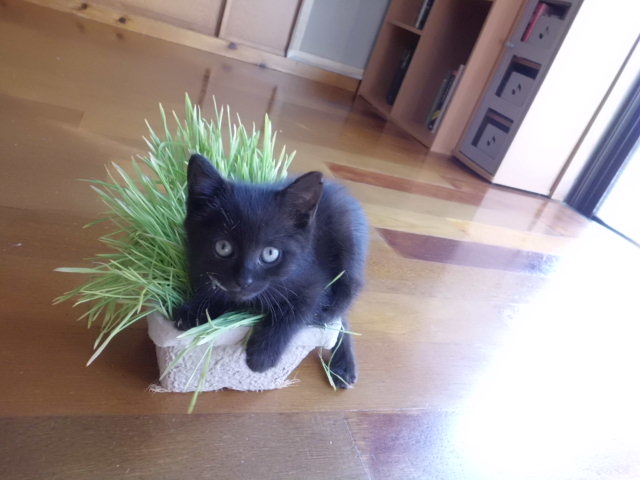
Ninja playing in her cat grass. Yes, Japan sells individual plots for our lovely kitty.
Although we had no idea about her background, my husband and I took her into our humble abode. She’s been conquering every space of the apartment since she arrived–and I have no problem with that. Everything about her is black–her fur, her gums, even her button nose–except her bright green eyes. The green disappears the moment she spots me walking barefoot around the apartment before she pounces on my feet like a miniature panther. When I take a nap, I find her napping right next to my head, fast asleep.
The first night with Ninja was pretty exciting for me, and I’m sure, for her as well. I haven’t owned a pet since I was thirteen years old, and I really love them, especially cats. We put her in a box lined with a pink towel, and she curled up in the box and fell asleep. She didn’t meow or seemed scared. My husband, drunk as he was, fell asleep as soon as his head hit the pillow, but I couldn’t sleep soundly. I was thirteen years old again, feeling the excitement of having a cute little kitten in my home again. Around 5 AM, I heard her disappear out of the box. I couldn’t find her as I went through the house and found where she went to the bathroom. The excitement dampened (she ignored the makeshift kitty litter at the threshold of the bedroom), but I discovered her back in her box. I sat down next to the box, and her first meow came out of her mouth. It was small, almost the sound of a garbled, unused voice. She climbed on me, nuzzling me, until she settled on my lap and promptly fell asleep. That’s when I knew she was going to stick around.
In one weekend, we bought ninja many things: a “cat condo”, a pot of “cat grass”, a cat carrier, a large kitty litter, and various cat toys. The funny thing is she doesn’t need much to stay entertained. She likes a Daiso darts ball with Velcro, a braided draw string from my basketball shorts, and a used Spongebob plushie. And she’s really like a ninja; she’s stealthy and fast–until she attacks.


Good article. If you want to save on tours in English, make friends with the local university students. Most who have an English-related major want practice in English, so they give tours around the city for less money. They just want the speaking experience!
You know, traveling on trains is really convenient, but I wouldn’t sleep on the train if you’re new to the Japanese trains or if you’re traveling alone. Sometimes, you won’t get the chance to sleep because many times, there’s a lot of people on the trains. Take a nap when you’ve got the buddy system going on.
Read the Article at HuffingtonPost

My husband bought me two Magical Realism books, Imaginaire II and Imaginaire III. They are expensive, but they’re worth the price. I found some of my new favorite artists.


I come from a Filipino family, so lumpia, or eggrolls, are a common item at the dinner. Since I moved to Okinawa, Japan, I haven’t seen any lumpia–or, at least I didn’t think I did. In Okinawa, lumpia is called harumaki (ハルマキ), stuffed with the same fillings (grounded meat, carrots, onions, and seasonings). Despite my twenty-six years of living, I have never made lumpia from start to finish. My nay (“mother” in Tagalog), the master at lumpia in the family, always prepared everything, and my brothers and I would sit down to roll around fifty to a hundred lumpia. Now that I live thousands of miles away, making seemed easier than when my mom had catering deadlines and fundraisers looming over our heads. The lumpia wrappers come in small packs that you can buy at any local store. My husband and I mixed together grounded pork and beef with carrots, onions, green peppers, eggs, pepper, salt, garlic, and basil. I could only go by smell and consistency to make the lumpia before rolled out twenty lumpia and fried them. For our first time making lumpia on our own, they turned out really good.


 Jade's Escape