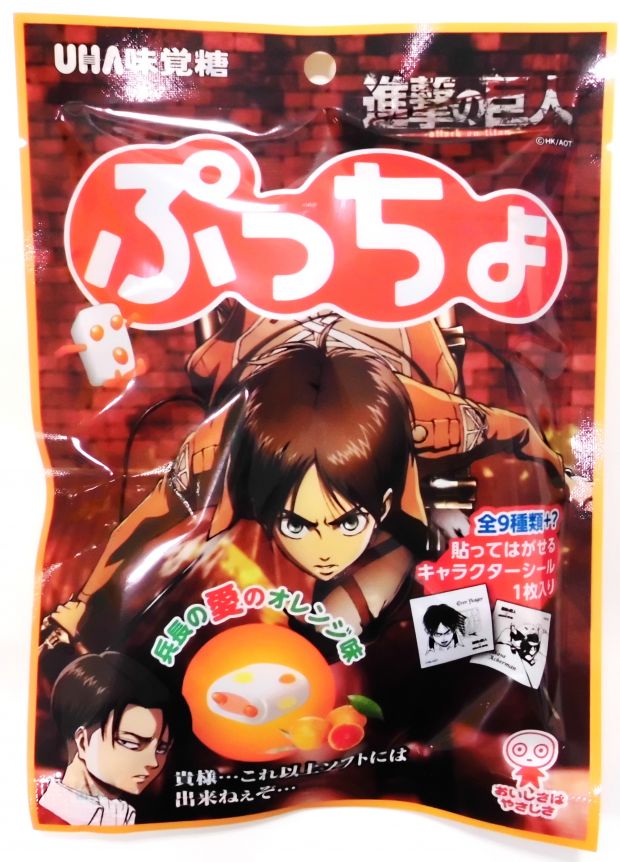
The winner of this contest is… SYS, an Indonesian manga artist of Sang Sayur (The Edibles). She not only claims several packs of screentones but an Attack on Titanpuccho, or soft chew, candy (only in Japan) and a few other treats that’re only in Japan.
Want to win stuff straight from Japan? Look for the next contest announcement in Jade’s Escape’s posts!
Every month, there’s always new chocolate appearing on my desk. Gotta love Japan, Land of the Omiyage!
FEBRUARY – A librarian I talk to every week gave me this cat chocolate as a トモチョコ (tomochoko), or friend’s chocolate, which is becoming more common between women on Valentine’s Day. In Japan, Valentine’s Day is a day where girls give boys chocolate and sweets. No, it’s not a day to subject Japanese women to being, well, subjected. On March 14, boys “return” the chocolate and sweets that was given to them by the girls. As Japanese girls become women, they still do this tradition, but I’ve noticed how every year, the women get more disgruntled with giving ギリチョコ (girichoko), or obligation chocolates. I suppose this friend’s chocolate is a way of saying, “Valentine’s Day isn’t just for guys.”
MARCH – This one came from my student who went to Tokyo as part of her school trip. Every year, Japanese students (usually second years or eleventh graders) visit different parts of Japan. I understand going to different parts of the country, but its really hard for poor students. They usually pay anywhere from $1,500 to $4,000 to make this week-long trip. My student went to the Skytree, the new tower in Tokyo (not to be confused with Tokyo Tower).
APRIL – This $5 chocolate is one I bought for myself at Lawson’s (one of many convenience store chains in Japan). It features characters from my favorite recent anime, Attack on Titan (新劇の狂人, Shingeki no Kyoujin).
You can also check out some apps that give you free or cheap access to licensed and new manga.
Manga Box App – This English and Japanese app provides popular manga like Nisekoi and Kindaichi Case Files along with lesser known titles such as Spoof on Titan, Chubby Cinderella, and Shinjuku DxD. This app is a free download for Android and iPhone.
Okinawa’s pissed. Why? The Okinawan governor recently sold out for another U.S. base in Henoko, the dangerous Ospreys (planes with a helicopter design) crash into a local university, and the rapes and incidents between American military men and Okinawans have people ready to deport all foreigners off the island.
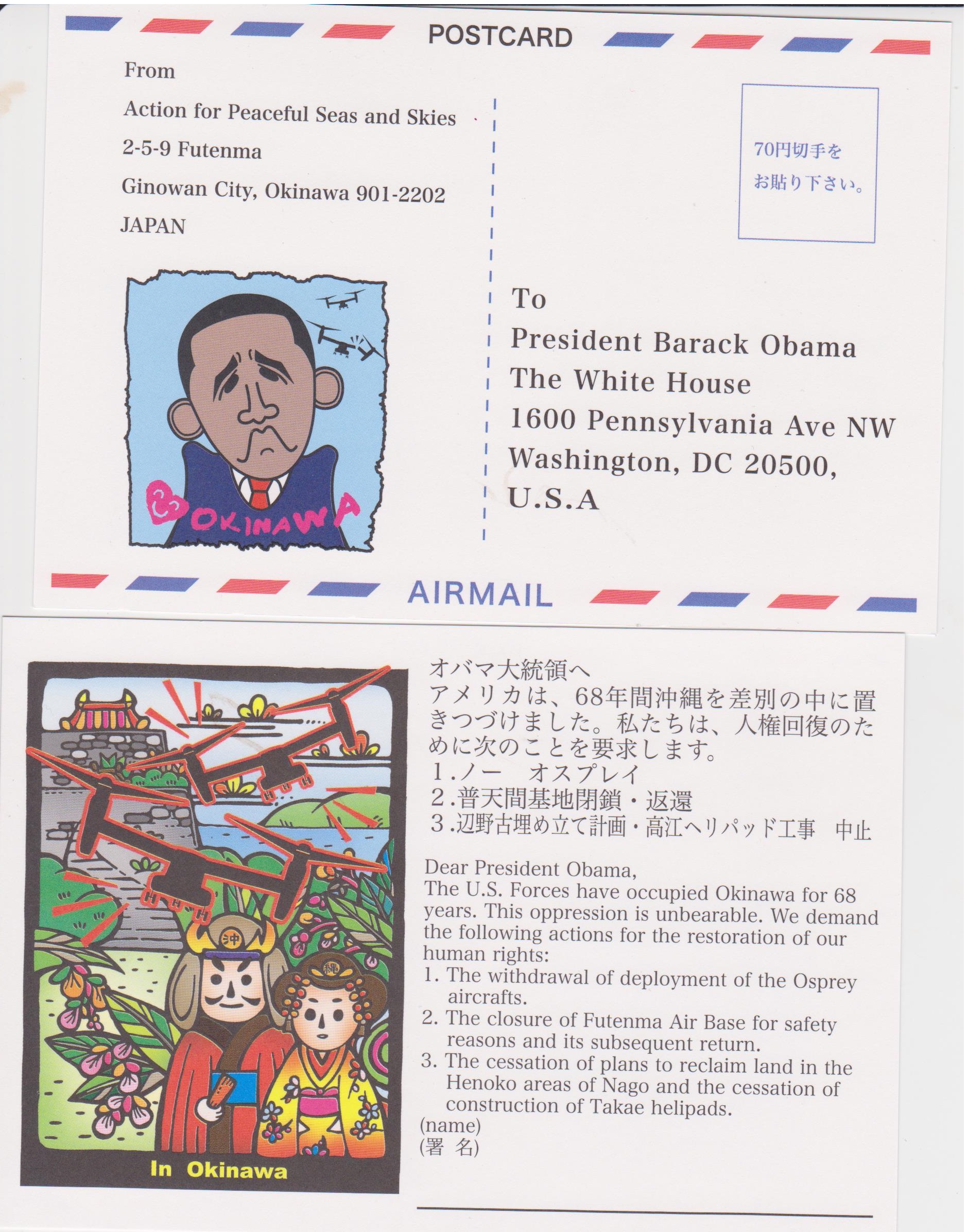
It wasn’t a big surprise to noticed this little postcard in the back of the teacher’s office this morning.
In case you can’t read the postcard, it says:
“Dear President Obama,
The U.S. Forces have occupied Okinawa for 68 years. This oppression is unbearable. We demand the following actions for the restoration of our human rights:
1. The withdrawal of deployment of the Osprey aircrafts.
2. The closure of Futenma Air Base for safety reasons and its subsequent return.
3. The cessation of plans to reclaim land in the Henoko areas of Nago and the cessation of construction of Takae helipads.”
I know what you’re thinking: “As an American, why should I care about these brown Asian folks from some nowhere island?”
You’re a human being, right? Well, OK, let’s use something more practical: money. If you’re an American paying taxes, you should know that you’re paying for the stealing of someone else’s land that you won’t be able to go to even if you made it to Okinawa. You’re paying for the crashes and damages done by Ospreys, something that costs over $69.3 million for one aircraft. You’re giving a paycheck to rapists and pillagers.
And, no, I’m not being anti-American. I’m doing my duty as an American and questioning where my money’s going, where the soul of humanity has flown off to. “Our country is not the only thing to which we owe our allegiance. It is also owed to justice and to humanity. Patriotism consists not in waving the flag, but in striving that our country shall be righteous as well as strong” (James Bryce).
If you don’t feel a single emotion over this, you’re heartless, soulless, downright suicide material ready for the elevator to 6-Feet Under.
Right now, there are many articles circulating the web about the anniversary of the Great East Japan Earthquake and its subsequent tsunami that took over 15,000 lives. I preferred Mainichi Shinbun‘s (Every Day Newspaper) short article so far (http://mainichi.jp/english/english/newsselect/news/20140311p2g00m0dm034000c.html).
But I’m not here to recap this sad marker in Japan’s history.
There’s still a lot of work to be done and a lot of help to be given. Thousands have been displaced by this event from 3 years ago. We should remember to be human and help those that are in need.
Japan should be called “Land of the Forgotten Commercials” starring Western actors looking for some easy money and international fans outside of their famous roles.
The former California governator, Arnold Scwarzenegger, made many Japanese commercials in his younger days for Nissin’s Cup of Noodles, Arinamin C Drink, and Direct TV. In the commercial above, he stars as a foreigner gambling with Japanese middle-aged men. In superhero fashion, he dashes away to pull out a Japanese energy drink while saying, “Good!”
Leonardo DiCaprio (Great Gatsby remake) in Japanese commercials mean that regular items like whiskey are going to be promoted as cool, premium items–even if those products will be sold for 800 yen ($9) at the local supermarket. Here’s Leo in a recent Cool Bourbon Jim Beam commercial.
Although Bruce Willis (Die Hard) tries hard to say his Japanese lines in these Daihatsu commercials with the disapproval of the director, he still looks very awkward and dubbed in every scene. I think taking the same measure as his Hollywood pals and saying very little (or nothing at all) would help.
The actor who takes the cake–er, the coffee–is acting veteran Tommy Lee Jones (Men in Black series). He didn’t just star in commercials for different products. Even to now, he’s a face for the canned coffee brand, BOSS. Everywhere in Japan, his wrinkled face adorns BOSS vending machines and ads.
1. Lose weight. I managed to lose 15 pounds from July to November by exercising 3 to 4 times a week. Injuries got in the way. I injured my left knee twice in June and July and strained my neck in December. Even though I’m starting from zero again for 2014 (at 154 pounds, only 1 pound lighter than last year), I’ve figured out the exercise program that works for me.
2. Learn Japanese. I had planned to take the Japanese Language Proficiency Test (JLPT), but I missed the deadline. Still, this year, I finished one full journal in Japanese, applied for a Japanese speech contest for foreigners, and re-started organized Japanese studies with an advanced course.
3. Save more money. I didn’t save more money this year. I spent more money (yikes!). I did, however, started seriously paying off my student loans and my husband saved the majority of money.
4. Travel more. Because of our savings, my husband and I decided not to travel.
5. Get to reading and writing! 2013 was a good year for me in regards to writing and reading. I won a science fiction writing contest and one of my stories was selected for a science fiction anthology. I also read 32 books out of my Goodreads’s goal of 30 books in a year. Along with my writing and reading progress, I took two very insightful Coursera classes: Comic Books and Graphic Novels (University of Boulder) and Fantasy and Science Fiction: The Human Mind, Our Modern World (University of Michigan). They helped me improved my writing style and approach to fiction.
Now that I’m staring my 2013 resolutions in the face, I understand why most of these goals failed. They’re so broad! I need concrete, realistic goals, not general ones that can be transposed from me to another person.
So here’s another shot at my resolutions:
1. Lose 25 pounds in 2014 and keep it off. If I exercise 30 minutes 3 times a week every week for a year, that’ll make 144 workouts in a year. This is possible if I look at it as in half a pound a week is lost in 48 weeks (a year). Luckily, I’ve found some great workouts online for free (save money!) and I can put my birthday gift to use (Nike Plus Fitness on Kinect). And, since my husband and I have decided to only eat meat in one meal a day, we’ll be helping each other stave off the pounds.
Ultimate goal: Weigh 130 pounds.
2. Take the lowest level of the Japanese Language Proficiency Test (JLPT). I missed the deadline last year, but I have another chance in July. I have a tutor to help me with this resolution now, and I can concentrate on kanji (Chinese writing system) and grammar through old textbooks.
Ultimate goal: Pass N1 of the JLPT, finish 2 Japanese journals, and pass my Japanese advance course.
3. Pay off 100% of my last credit card, pay off 95% of my student loans, and save at least $1,000 a month. This is totally possible if I ignore the horrid yen-to-dollar exchange rate. From October, I already implemented my student loan pay off. This year, I have to take the reigns of my budgeting plans by creating monthly bill deadlines and alerts.
Ultimate goal: Have $0 on all credit cards, have $700 left on student loans, and have $10,000 in savings.
4. Read 50 books this year and win 2 writing contests. I’ll have to pace myself and read more e-books while I’m at school. I need to develop a writing schedule and stick with it for the year.
5. Create 8 manga podcasts on Anime 3000. I’m a manga podcaster for Anime 3000’s Manga Corner. I was able to release only 4 manga podcasts last year. I’d like to re-vamp the show a little and interview 8 different guest stars. If you’re an anime, manga, or Japanophile podcaster, you can contact me (mangacorner [ at ] anime3000 [ dot ] com) about being a guest star.
Maybe you’ve seen a happy-go-lucky bear, maybe you haven’t. If you’re in Japan, you’re likely to see him on everything. Yes, I mean, everything. Tissue boxes, frozen fried rice packages, candy, cookies, soba bags…I think even on Ninja‘s shaved tummy (from her spay).
Kumamon is a mascot bear from the Kumamoto Prefecture. Since his creation in 2010 from the Kumamoto Surprise campaign for tourist through the new Kyushu Shinkansen line, Kumamon has become a hit in Japan. In 2011, he won a national mascot contest, generating a large revenue prize for the Kumamoto region.
Kumamon isn’t just a prize winner; he’s a profit builder as well. Anything with Kumamon is expected to be bought up. Is it because of his sheer cuteness? Who knows? All I know is that Kumamon looks very much like my Bombay cat.
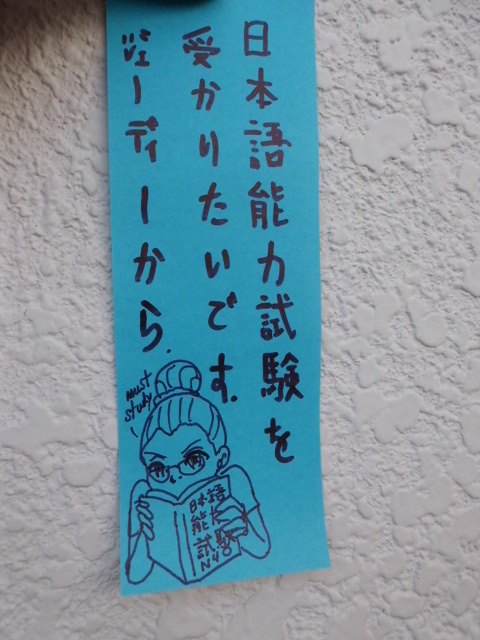
People usually write wishes (お願い) for Tanabata and tie them to a bamboo branch. My wish this year: “I want to pass the Japanese Language Proficiency Exam”.
There are many festivals celebrated throughout the year in Japan. However many festivals exist in Japan, there is only one fixed festival that honors the representation of stars: hopeful wishes.
Tanabata (たなばた,七夕), or the Star Festival, is celebrated every year on July 7th all over Japan with local variations. It honors the legend of two lovers separated by the Milky Way. Fortunately, the lovers, Cowherd Star, or Altair, and Weaver Star, or Vega, are allowed to meet once a year on the evening of July 7th.
The legend, which is derived from a Chinese folktale known in Japanese as Kikkoden (きっこでん, 乞巧奠), is about a cow herder named Hikoboshi and a weaver princess, Orihime, who played together so much, they forgot their duties, upsetting the king. In response, the king separated Hikoboshi and Orihimi by a river called Amanogawa River, or the Milky Way. However, Orihimi begged the king to allow her to see Hikoboshi again, so the king set aside one day for them to meet. Though tanabata’s legendary story is one about two lovers, the festival itself is a time where wishes are asked to come true.
During tanabata, people write their wishes onto small and colorful strips of paper called tanzaku (たんざく, 短冊). Once the tanzaku are hung onto bamboo stalks or trees and displayed in their yards and home entrances, people pray for their wishes to come true. The next day, the decorations with the tanzaku are released into oceans, rivers, or streams. Colored streamers are also used to show off the tanabata spirit around the neighborhood. Other decorations include a casting net, or toami (とあみ, 投網), for good luck in fishing and farming, and a purse, or kinchaku (きんちゃく, 巾着), for wealth and good business.
Each area of Japan celebrates tanabata differently. Several areas light torches as part of the celebration, while others use horse-shaped puppets instead of bamboo stalks for displaying their tanazaku. Though tanabata is largely celebrated on July 7th, some areas of Japan celebrate tanabata on August 7th alongside the ancestral summer holiday, Bon (ぼん, 盆), which honors the return of the family’s ancestors. Outside of Bon, some cities couple tanabata with another celebration. Aomori of the Touhoku Region also celebrates the star festival with the Nebuta (ねぶた)Festival, parading lanterns made of papier-mache alongside customary tanabata decorations.
Amongst all of the tanabata celebrations, Sendai of the Miyagi Prefecture and Hiratsuka of the Kanagawa Prefecture are known to have elaborate tanabata events. Because of this, Sendai and Hiratsuka have become tourist attractions during the month of July.
With the exception of the original tale, tanabata is one of Japan’s celebrations where hopes and wishes are requested in full festival fashion.
Renshaw, Steve and Saori Ihara. (1999). “Orihime, Kengyuu, and Tanabata: Adapting Chinese Lore to Native Beliefs and Purposes”. Appulse; Bulletin for the Philippine Astronomical Society. Vol. 9:8. August, 1996. http://www2.gol.com/users/stever/orihime.htm.
In January, I posted my New Year’s resolution. Now, six months later, I’m doing a check-in.
Gotta get that fat outta here!!
#1: Losing weight: Drop 25 pounds.
In January and February, while my husband did a cleanse, I opted for only eating meat once a day. I don’t know if I dropped weight, but my clothes did fit differently–good for not exercising (my husband did, though). Just when we were going at a good pace, my husband hurt his back and the exercising (for him) and the non-meat meals stopped. It goes to show how much being in a relationship can affect your body.
Three weeks ago, I started doing Tae Bo again. It wasn’t as bad as I remembered (I did it last year for two months), but I decided to do cardio three times a week and strength training once a week. A week ago, I hurt my knee, so I’ll have to stick with strength training and minimum cardio. Injuries are the worst!
Plan: Do 30-45 minutes of exercise every other day. Two times a week include a strength training regiment (12 reps, 3 sets with weights), and work on abs every exercise day.
How to write “learn” in kanji
#2: Learn Japanese: Become a more fluent speaker.
I entered an international speech contest in Japanese, but I wasn’t picked. Maybe next year… Every day, I learn a new Japanese word (today’s word is 野良猫, noraneko, or “stray cat”) to build my vocabulary. I also write in a journal in Japanese, and some of my posts on this blog have a Japanese translation. So far, my reading comprehension has gotten easier as well as my kanji.
Plan for the rest of the year: Sign up for the JET Programme’s free advanced Japanese course and get ready for another speech contest (to get picked this time!).
#3: Save more money
I haven’t saved any money (according to my Mint account), but I have managed to slim our daily expenses. Instead of buying many snacks and going out to eat, we cook at home and avoid sugary products like cookies and fruit juices.
Plan: Send a set amount of money to my American bank account and not touch it except for emergencies and bills.
#4: Travel more.
Because of Item Number 3, traveling is out of the question. Sadness!
Once upon a time, there was a writer…
#5: Get to reading and writing!
I became a part of a creative writing circle. We get a prompt and two weeks to write something, then we post in on Google Plus. It’s very convenient because I never know how people will react to it. Also, it keeps me on my toes in keeping with deadlines!
Plan: Continue with the writing circle. Win at least one writing contest!
In your country, do vending machines give weather forecasts and recommend a drink for you based on your gender and estimated age ( using facial recognition software) like here in Japan?
We can also pay for the drinks by using our train commute IC cards.
I came to Japan two years and eight months ago, and my Japanese is still broken. What the…OK, it’s not a big deal. I just live in Japan is all. Ever since I stopped doing the self-study Japanese courses (provided through the JET Programme), I haven’t been diligent in studying Japanese. I’ve tried to make up for the slack by entering a Japanese speech contest. My problem: I don’t practice every day. I do speak Japanese every day, but I don’t practice Japanese enough.
I’ve decided to learn a new Japanese word every day. I’ve decided this since Friday. The words I’ve learned since then are kangei (歓迎, “welcome”), ooku no (多くの, “many”), koma (駒, “piece”), and kaikai (開会, “opening of a meeting”). I suppose these choice of words alone show what’s going on in my life now.
At this time, Japanese schools are welcoming new teachers and students–and there are many this year at my school–while opening ceremonies and introduction games are taking place. Can you guess what word goes with what statement? Bet you can.
On top of that, I’ve discovered Japaneseclass.jp, a website designed for self-study (and competition, whatever way you look at it). Every time I pass a vocabulary question, I get points which up my ranking score out of everyone on the website. It’s a bit addicting, so I guess Japaneseclass.jp is doing its job.
In black is the old way of writing. In red is what each kanji means.
In today’s class, everyone went to the calligraphy and art classrooms. There were many beautiful calligraphy and art pieces. Some of the art pieces were impressive, so I decided to take a picture of them. Later on, I’d like to try to make a bag calligraphy.
Just as the States borrowed the hamburger, Christmas trees, and burritos from other countries, Japan has the same tendency. With Valentine’s Day, it’s no exception. But Japan did more than adopt Valentine’s Day into its social holidays; it made White Day (March 14) a secondary Valentine’s Day where only men give chocolates to women. The custom is if a male receives a gift on Valentine’s Day (where only women give gifts to men), the male must return a gift with three times the value of their Valentine’s Day gift.
Last year, most of female teachers at my schools complained about how the male teachers only bought them White Day gifts while they actually gathered together and made Valentine’s Day gifts. This year, the sports club teachers actually made a poor man’s tiramisu (an Italian dessert) consisting of vanilla pudding, graham crackers, and cocoa powder. No complaints from the female teachers. Everyone, including all of the male teachers who didn’t participate in the tiramisu-making, was impressed. On top of the tiramisu, I received a dainty tin can with chocolates from the English department and a small box of Belgium chocolate from the basketball coach. All of the gifts were delicious, so I’m really happy I didn’t take a day off!
Coming to Japan, I thought English education would be more advanced. What I found was a little disappointing: people who have studied English for ten years couldn’t form an English sentence. Even as more English speakers in Japan come forward as English teachers or translation experts, it’s easy to hear some really strange (and straightforward) English phrases in Japan.
David Sein’s 日本人のヘンな英語 illustrates in manga form the differences between Japanese people’s English and native English.
I think one reason why it’s hard for Japanese people to speak English is that it’s so direct. For instance, if someone says, “本を見ました,” the meaning could be, “I looked at the book” or “I saw the movie” (or if there are legs coming out of the book, “I watched the book”). 見る, or miru, has several meanings: look, see, or watch. Just picking which meaning to use is hard for Japanese speakers.
Sometimes, English idioms are taken quite literally. In English, “I cut the cheese,” isn’t used literally—someone cuts a piece of cheese with a knife—but it’s usually the image in Japanese people’s heads when this phrase is said. English speakers, however, see it as someone busting a stinky, dark cloud from their butts. In the Lang-8 blog, the blogger also noted how Japanese people are taught some strange English from Japanese words. Several words in Japanese aren’t translated very easily into English because its particular to Japanese culture. いただきます, or itadakimasu (literally “I humbly receive”), is a word said before anyone eats a meal in Japan. The meaning of it is lost in translation, especially in English when a person usually says, “Thanks for the food,” or “Let’s eat!”
David Sein’s 日本人のヘンな英語 is available for 1,050 yen on Amazon.co.jp.
When someone has two different personalities, they’re called, “ジキルとハイド,” or “Jekyll and Hyde” in English. Based on the Robert Louis Stevenson’s A Strange Case of Dr. Jekyll and Mr. Hyde, the names have not only been used for dissociative identity disorder in Western culture but also in Japanese culture. To say, “jikiru to haido,” to someone’s face is a little harsh, even if it’s true. (I recently met a teacher who is calm during office hours, but outside of the office, he becomes what teachers have said, “Jekyll and Hyde” or a “monster”.)
There is a manga called ジキルとハイドと裁判員 (Jikiru to Haido to Saiban-in), translated as Jekyll and Hyde and the Citizen Judges (also, the word “saiban-in” can be “jury” or “lay judges”). It still follows some of the original story from the 1886 novella, but it includes a supernatural twist that only Japan can do.













 Jade's Escape