ジキルとハイド: Split Personality in Japan

jekyllandhyde

When someone has two different personalities, they’re called, “ジキルとハイド,” or “Jekyll and Hyde” in English. Based on the Robert Louis Stevenson’s A Strange Case of Dr. Jekyll and Mr. Hyde, the names have not only been used for dissociative identity disorder in Western culture but also in Japanese culture. To say, “jikiru to haido,” to someone’s face is a little harsh, even if it’s true. (I recently met a teacher who is calm during office hours, but outside of the office, he becomes what teachers have said, “Jekyll and Hyde” or a “monster”.)

ZZ_JekyllHydeCitizen-01_FID_178x250

There is a manga called ジキルとハイドと裁判員 (Jikiru to Haido to Saiban-in), translated as Jekyll and Hyde and the Citizen Judges (also, the word “saiban-in” can be “jury” or “lay judges”). It still follows some of the original story from the 1886 novella, but it includes a supernatural twist that only Japan can do.

For Emerging Manga-ka: Technique Book Recommendation

One thing I like about living in Japan: I can read Japanese manga technique books for free. The book I picked up from the school library was Tokyo Institute of Animators’s 思いいどおりのキャラが描けるテクニックBOOK, or Character Technique Book (literally “techniques so that one can draw the expected character”).

Character Technique Book is a 単行本, or tankoubon, meaning “special volume” usually from a series of lectures.

This book’s best aspect: showing how to draw people, weapons, animals, and places from the preliminary sketches to the finished product. Even how to color pictures (digitally and traditionally) is outlined. For all emerging comic artists (and those who can read Japanese), I would recommend this book.

There are also other technique books like this such as Cool Male Characters Technique Book (loose translation of カッコいい男のキャラの描けるテクニックBOOK) and Cute Girl Characters Technique Book (loose translation of かわいい女のキャラの描けるBOOK).

Character Technique Book is available for 1050 yen on Japan’s Amazon website. You can also find this book as How to Draw Manga Character Background Technique Book on Amazon.com for $33.18.

Valentine’s Day in Japan

I always thought that the way manga and anime depicted Valentine’s Day–with girls making chocolate and confessing their hidden feelings to a boy–wasn’t a truedepiction of the day in Japan. I was wrong.


I learned about oppai choco, or boobs chocolate. How I got this beautiful, tit-shaped chocolate is amazing to me. One of the Yakuit-brand ladies came to my school to sell healthy Yakuit yogurts and drinks. Because it was Valentine’s Day, they gave all their customers a sa-bisu (“service”) chocolate–the boobs chocolate. The vice principal, the office workers, the teachers, we all received this edible nipple in return for buying healthy food.

Most Famous Baseball Coach in Okinawa

At 4 PM, all of the office workers watched the tiny box-of-a-TV. “The baseball game is playing. Okinawa is in the championship,” my co-worker told me as our supervisor adjusted the antennas. The team was Konan High School, the last standing Okinawan team in the 2010 National High School Baseball Summer Tournament. They beat out 46 teams, making Coach Masaru Gakiya the most famous baseball coach in Okinawa.

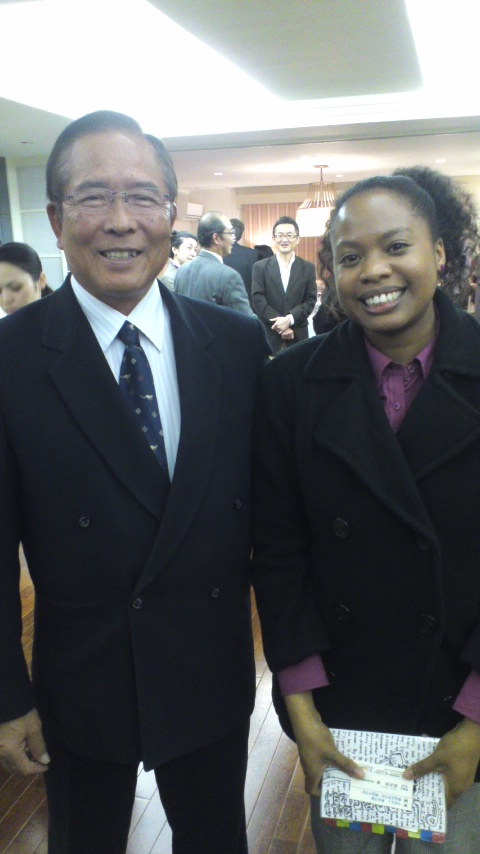
I met him at a private event by the U.S. Consulate, and from all of the Americans present, I think I visibly showed my excitement to be in the same room.

Yaese Town Cherry Blossoms Festival 八重瀬町桜まつり

Image Hanami, or cherry blossoms viewing, is usually seen throughout Japan in March and April. This year, in Okinawa, the cherry blossoms have bloomed early–but their flowers aren’t as bright as the years before. It’s OK, though. Many festivals in honor of these beautiful, pink flowers have cropped up just as early as the cherry blossoms’ blooming. One festival that my husband and I went to was the Yaese Town Cherry Blossoms Festival. 

We arrived in the latter part of the event, but we didn’t miss out on the festivities. After walking up a long hill overlooking Yaese Town and climbing multitudes of stairs (and a kind grandmother commenting loudly, “Mada?” when we encountered another set of stairs), we finally reached the top of the small mountain. The smell of corn dogs, yakisoba (sauteed noodles), and french fries filled the air as music by a local J-rock group sounded from a big stage flanked with large sakura poles. 

One thing about festivals that I absolutely love is the festival food. Fatty, greasy, and cheap, festival food can range from traditional Japanese food (sobaramen, takoyaki) to Western food (tacos, hamburgers, chicken nuggets). This time, there were a few vendors selling cheap vegetables, homemade cookies, and chicken pies. 

Image

Aside from the food, the Yaese Town festival had a treat for everyone: a tug-of-war contest. The rope was as thick as my body! It took over twenty people to carry one side of the rope in traditional fashion around the festival grounds. After some (quiet) taunting from both sides, we grabbed the ropes and pulled. It was a hard fight, but the other side managed to pull us over the line. The second time was fruitful: we won in less than five minutes. 

We dusted ourselves off, carried the rope again, and then disappeared down the stairs to the cave. It was once used as a medical center for the Okinawans during World War II, and still stands as a historical reminder to all. Many of the elementary school students asked us as we exited the cave area, “Do your pictures have ghosts in them?”

I don’t know if this counts as a ghost; there’s a small circle to the right of my husband. Just so you know, there wasn’t a light inside the cave. We checked.Image